
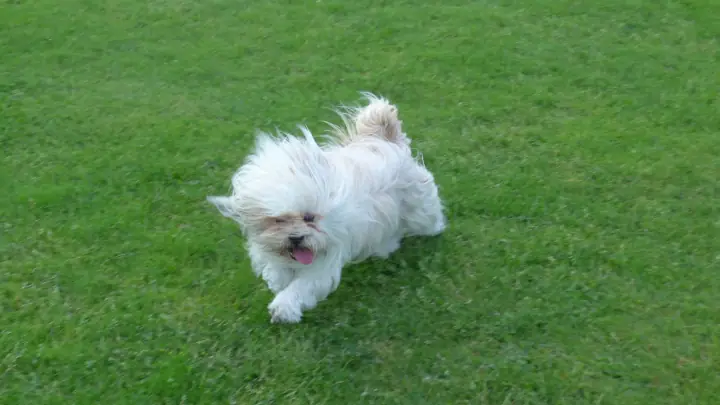
HDB-APPROVED · DOG BREED GUIDE
Last updated First published 31 May 2026
Notice one little habit together →A small idea to try, with progress kept in your Pack.
Also known as Lhasa, Apso Seng Kyi, Tibetan Lion Dog.
Thinking about adopting a Lhasa Apso?
Years as a Himalayan guardian have prepared the Lhasa Apso to watch over your HDB corridor, with only its regal fur standing between you and a resignation to floor-washing.
Can a Lhasa Apso live in an HDB flat?
YesOn the HDB approved-breed list
Named on HDB's approved small-breed list for flats. Check any listed variety restrictions and confirm the individual dog before committing.
HDB sets and maintains the approved-breed list. Check the current rules at HDB.gov.sg →
Full list of HDB-approved breeds on this site →At a glance
- Size category
- Small
- Weight
- 5 to 8 kg
- Height
- 25 to 28 cm
- Lifespan
- 12 to 15 years
- Energy level
- ●●○○○ 2/5 (editorial, unvalidated)
- Shedding
- ●●○○○ 2/5 (editorial, unvalidated)
- Heat tolerance
- ●●○○○ 2/5 (editorial, unvalidated)
- Barking
- ●●●○○ 3/5 (editorial, unvalidated)
- Trainability
- ●●●○○ 3/5 (editorial, unvalidated)
- Grooming needs
- ●●●●● 5/5 (editorial, unvalidated)
- Origin
- Tibet
Editorial climate-care note
Heat tolerance rated 2 out of 5. The Lhasa Apso's long, heavy double coat is designed for cold Tibetan winters, making it poorly suited to Singapore's 28 to 32 degrees Celsius heat and humidity. Walks must be strictly before 8am or after 7pm, kept under 20 minutes. Air-conditioning is necessary at home. Many owners keep the coat clipped short in a "puppy cut" to help with the climate.
This score is not a safe temperature or exercise limit. Any dog can develop heatstroke.
Plan activity around your dog, not a timer
A breed score cannot tell you how many minutes are safe today. Avoid hot conditions, watch your dog's breathing, and agree an activity plan with your vet.
Read PDSA's heatstroke guidance →Common health issues in Singapore's climate
Build a care budget
- Year 1
- S$4,365 to S$5,905
- Over 10 years
- S$40,395 to S$54,653
Illustrative planning assumptions for food, grooming and routine vet care, with inflation and a year-one setup uplift. These are not verified provider quotes or a lifespan prediction. Adjust the calculator to current quotes; add insurance, boarding and emergencies separately.
Run the full lifetime cost calculator →The Lhasa Apso spent centuries as an indoor sentinel in Tibetan monasteries and palaces, a small dog whose entire job was to notice things and say so. It was never a lapdog and it has never really agreed to become one, which is the single most useful thing to understand before you bring one into a flat.
It is on HDB's approved list, energy is rated a very manageable 2 out of 5, and it will happily live in a two-room flat. It also has the highest grooming line on this site at about S$1,800 a year, a coat built for a Himalayan winter, and a considered opinion about everyone who walks past your door.
Personality and temperament
Lhasas are dignified rather than demonstrative. They are affectionate with their own people and genuinely reserved with strangers, which is not shyness or nerves but the remains of the job. A Lhasa assesses a visitor before deciding, and it does not particularly care whether you approve of the verdict.
Beginner friendliness is rated low on this page, and that rating is about independence rather than difficulty. Trainability is rated 3 out of 5: this is a clever dog that does not consider your instruction self-evidently correct, and owners who expect Poodle-style eagerness find it stubborn. Owners who expect a cat-adjacent housemate with strong self-possession find it delightful.
Energy is rated 2 out of 5, one of the lowest on the site, which is a real advantage in this climate. Barking is rated 3 out of 5, moderate, and it is alert barking with a purpose. It is rated good with children and good with other dogs.
Exercise in Singapore's climate
Heat tolerance is rated 2 out of 5, and it is the coat rather than the size that does it. The Lhasa carries a long, heavy double coat designed to keep a small animal alive on a Himalayan plateau, and that specification does almost nothing useful at a daily maximum of 31 to 33 degrees Celsius with average relative humidity around 82% year round (Meteorological Service Singapore).
Brachycephalic also appears on this page's health-issue list. The Lhasa's muzzle is shortened, though far less severely than a Pug's or a Griffon's, so airflow is somewhat reduced and the heat margin narrower than the modest energy level suggests.
The good news is that 2 out of 5 energy makes the schedule easy to honour. Two walks a day of fifteen to twenty minutes, before 8am and after 8pm, in shade, with water. That is genuinely enough for this breed.
Indoors, a puzzle feeder and a few minutes of scent work keep an intelligent dog from becoming an opinionated one. A Lhasa does not need running, it needs occupying.
Coat and grooming in the humidity
Grooming needs are rated 5 out of 5, the top of the scale, with the highest grooming line on this site at about S$1,800 a year. Shedding is rated 2 out of 5, low. That combination is the whole trade.
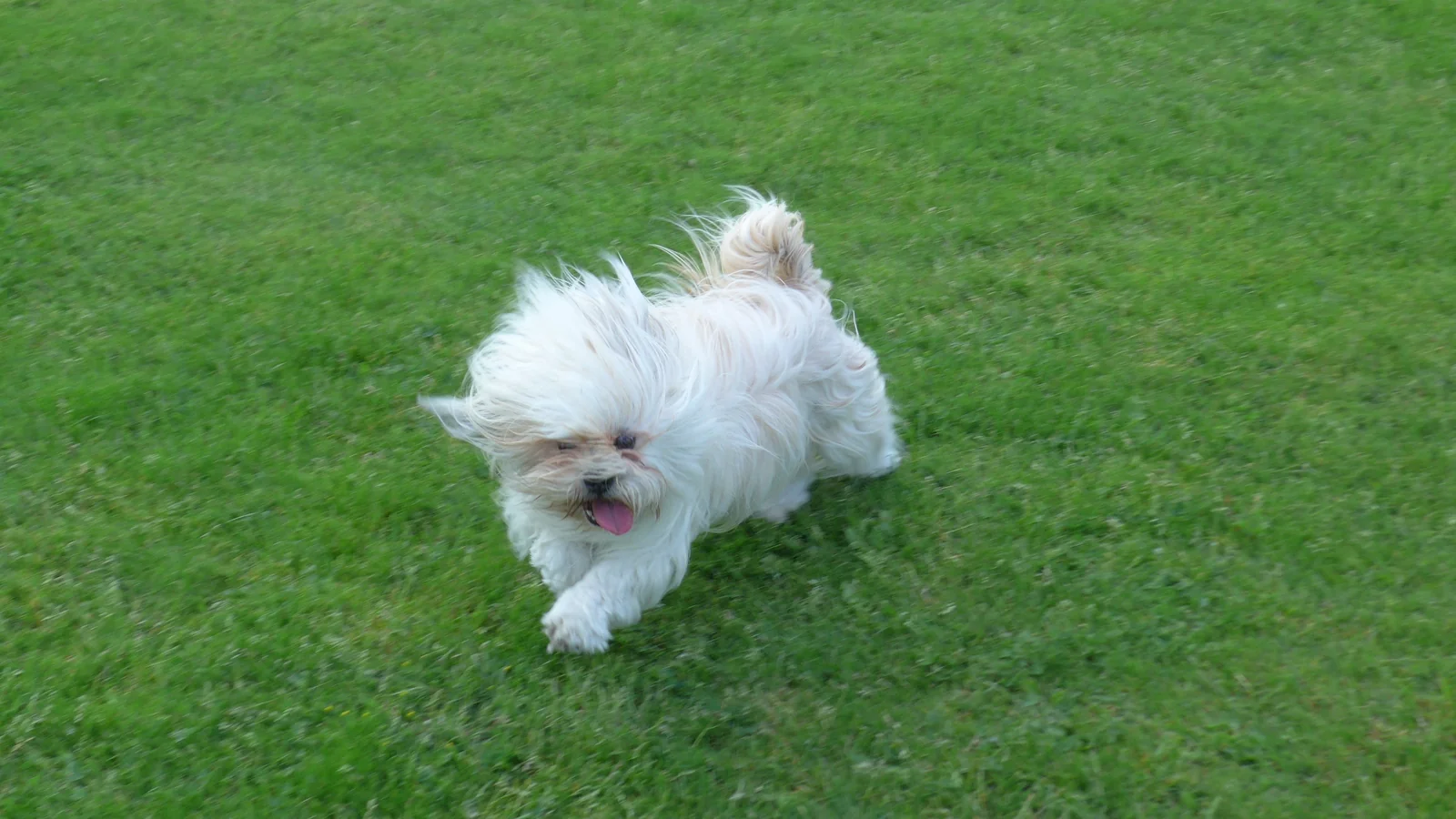
The floor-length parted coat this breed is shown in is not a realistic proposition for a pet dog in Singapore. It mats, it drags, it collects the environment, and in this humidity it holds moisture against the skin. Almost every sensible Lhasa owner here keeps the dog in a short practical trim, sometimes called a puppy cut, and the dog is considerably more comfortable.
Even short, this coat needs combing to the skin several times a week, with real attention behind the ears, under the collar, in the armpits and around the back end. A double coat mats from the base outward, so the surface tells you nothing.
Book a groom every four to six weeks. Ask for the face to be kept workable: the hair that falls over a Lhasa's eyes needs either tying up or trimming back, because eye conditions lead this page's health-issue list and hair sitting against a cornea is an avoidable irritation.
Dry the dog to the skin after every bath and every wet walk. A damp double coat in 82% humidity is how skin problems begin, and on this coat you will not see it starting.
Diet and feeding
Food runs about S$850 a year. With energy at 2 out of 5, this is a breed that gains weight easily, and there is no obvious visual warning under all that coat, so you are assessing by hand rather than eye.
Weigh the food, count treats inside the daily total, and ask your vet to body-condition score at every visit. Patellar luxation is on this page's health-issue list and extra weight goes through the knees.
Urinary issues are also listed, so keep water available and refreshed through the day, and treat a change in toileting pattern as a veterinary question rather than a behavioural one. Going more often, straining or an accident from a previously reliable dog are all worth a visit.
Dental health is on the list too. A small crowded mouth over a 12 to 15 year life needs daily brushing, not an annual scale.
Training
An independent dog responds to being paid rather than told. Three priorities:
- Grooming tolerance, treated as the main project. Combing several times a week and a groomer every four to six weeks for fifteen years. A Lhasa that has been handled kindly from week ten will lie still for it. One that has not will fight, and the owner who loses that fight ends up with a shaved dog and a skin problem.
- The "quiet" cue, from week ten. Moderate barking with a watchdog's sense of duty still needs shaping in a block of flats. Reward the settle after the alert rather than trying to suppress a job the breed has held for centuries.
- Careful, generous socialisation. A naturally reserved breed becomes a comfortable one through early, positive, unpressured exposure to strangers. Let the dog approach rather than being approached.
Health
The UK Kennel Club recommends a DNA test for progressive retinal atrophy (PRA4) and eye testing using the BVA/KC/ISDS Eye Scheme. It places the breed in Breed Watch Category 1, and states that "currently no points of concern specific to this breed have been identified for special attention by judges, other than those covered routinely by The Kennel Club breed standard".
Both recommendations point at the eyes, and so does this page's own health-issue list, where eye conditions sit first. That agreement is unusual and it tells you where to concentrate.
Ask for the PRA4 DNA result on both parents. Progressive retinal atrophy is an inherited degeneration of the retina that ends in blindness, it is not treatable, and because the genetics are understood a breeder who tests simply does not produce affected puppies. There is no acceptable reason for this result to be missing. Ask for the eye scheme certificates as well.
Then ask for a written veterinary patella assessment on both parents, since patellar luxation is second on this page's list and the Kennel Club scheme does not cover it here.
The rest of the list is dental health, brachycephalic, urinary issues and Cushing's syndrome. On the brachycephalic entry, be sensible rather than alarmed: this is a mildly shortened muzzle, not a Pug's, but it does mean the heat margin is smaller than the low energy rating implies, and noisy breathing at rest in a parent is still worth noticing. Cushing's tends to appear in middle age and later, so increased drinking, increased appetite, a pot-bellied look or a thinning coat in an older dog deserves a blood test rather than a shrug.
Routine veterinary care runs about S$1,300 a year. Arrange insurance in the first weeks, before any eye, knee or urinary note is on a clinical record to be written back as an exclusion. None of this replaces your own vet's assessment of your own dog.
Housing and space in Singapore
The Lhasa Apso is named on HDB's published list of approved breeds for flats, which runs to 61 named breeds plus a cross of any two of them. Confirm the current position there before you commit, since HDB maintains and updates the list.
Ownership limits come from AVS rather than HDB. Under AVS's rules, an HDB flat may keep a maximum of one dog of an approved small breed plus up to two cats, and no dog on the Specified dogs list; private property may keep up to three cats or dogs in combination. Every dog needs an AVS licence. Licence fees depend on sterilisation status, age and the number of pets. One-time and three-year licences are different options. Check the current AVS fee table before paying.
With 2 out of 5 energy, floor area is close to irrelevant. Temperature is what matters. Give the dog a cool tiled place to lie out of the afternoon sun, and think about what the flat does between 11am and 4pm with nobody home, because a heavily coated dog in a closed-up unit has nowhere to shed heat.
Put the resting spot away from the front door, which for a breed with a monastery sentinel's instincts does more good than it does for most dogs. And put runners on polished tile, and steps up to any furniture the dog uses.
Care and cost in Singapore
On this page's figures: about S$850 a year for food, S$1,800 for grooming and S$1,300 for routine veterinary care. Grooming is the largest single line on this site for any breed, and skipping it in this humidity is how you convert a coat problem into a skin problem that costs more. Budget it as a fixed monthly commitment rather than a discretionary one. Run the ten-year picture with the cost calculator.
Getting a Lhasa Apso: buying and adoption
Ask for the AVS dog farm licence number, the PRA4 DNA results and eye certificates for both parents, and a written veterinary patella assessment for both parents.
Ask how the puppies have been socialised, because a naturally reserved breed raised without early varied human contact becomes a genuinely difficult adult, and that is the most common avoidable problem in this breed.
Ask what the breeder does about the coat in this climate if they are local. Anyone keeping a Lhasa here has had to make a decision about it, and a clear answer about clipping and drying tells you they are keeping dogs rather than producing them.
Adoption is realistic and worth pursuing. Lhasas and Lhasa crosses come through SOSD, Causes for Animals and Mercylight, and the grooming commitment is a recurring surrender reason, which is worth reading as information about the coat rather than about the dogs. An adult arrives with its temperament and its coat already visible, and given a reserved breed, seeing the finished character is a real advantage.
What to skip: any seller who describes this as a low-maintenance small dog because it does not shed much. Low-shedding and low-maintenance are opposites here.
Life stages: puppy to senior
Puppy, to about 12 months. Start combing daily from week ten, while there is hardly any coat, so the habit exists before it is needed. Socialise generously and without pressure. Begin daily tooth brushing and keep the hair out of the eyes from the start. Get insurance in force early.
Adolescent, roughly 9 to 18 months. The adult double coat arrives and the workload jumps, usually faster than owners adapt to. This is when most Lhasa coats are lost to matting. Increase combing now, and make the clipping decision deliberately rather than as an emergency at the groomer. Watch for a skip in the back legs.
Adult, roughly 2 to 9 years. Easy and undemanding, provided the coat routine holds. Weight checked by hand, teeth brushed, eyes kept clear, walks short and in the cool hours. Watch the toileting pattern for the urinary entry on this page's list.
Senior, from about 10 years. Lifespan here is 12 to 15 years. Move to twice-yearly vet visits. Watch for the Cushing's signs described above, for cloudiness or bumping into things in low light given the PRA picture, and for dental disease. Keep the coat short for comfort and keep grooming sessions brief and frequent rather than long, because standing gets tiring. Keep the flat cool.
See dog-friendly cafes and parks in your region → | Run the 10-year cost of a Lhasa Apso in Singapore →
Three things to know
-
Ask for the PRA4 DNA result by name
The Kennel Club recommends it alongside eye testing, eye conditions lead this page's own health list, and progressive retinal atrophy causes untreatable blindness that testing avoids entirely. A missing result is the end of the conversation.
-
Grooming is the highest cost on this site, at about S$1,800 a year
A Himalayan double coat in 82% humidity mats from the skin outward where you cannot see it. Keep the dog in a short practical trim, comb to the skin several times a week, and dry it properly every time.
-
It is a sentinel, not a lapdog, and that is the appeal
Reserved with strangers, independent, and rated 3 out of 5 for trainability. Socialise generously and early, reward the settle after the alert, and do not expect eagerness. Expect self-possession.
Annual cost in Singapore
Editable planning estimates, not verified provider quotes or a prediction of your dog's bills. Boarding, one-off equipment and emergencies are additional.
- Food
- S$850
- Grooming
- S$1,800
- Routine vet
- S$1,300
- Sum of the three
- S$3,950/year
Run the lifetime cost calculator →
Get a current insurance quote for your dog's age and circumstances. Compare exclusions, waiting periods, excess and cover limits. Compare policy questions here →
Frequently asked questions
Is a Lhasa Apso HDB-approved in Singapore?
Yes. The Lhasa Apso is on the HDB list of breeds approved for flats. Confirm the current HDB and AVS rules before you commit, as the approved list can change.
Do Lhasa Apsos bark a lot?
Our current barking assessment is: has a moderate bark (editorial estimate). It has not been independently validated. Ask about this dog's observed behaviour, triggers and time alone; the breed label cannot predict your neighbour's experience.
How much grooming does a Lhasa Apso need?
Our current grooming assessment is: needs a lot of grooming, including regular professional trims (editorial estimate). Confirm the individual coat-care routine and any professional grooming with the rescue, groomer or vet. The score is not a measured frequency or price.
How does a Lhasa Apso cope with Singapore's heat?
An editorial heat score cannot establish a safe temperature or walk duration for an individual dog. Activity, humidity, health, age and body shape matter. Avoid hot conditions, provide shade and water, and ask your vet about an appropriate activity plan.
Is a Lhasa Apso a good breed for a first-time owner?
Our household-fit note is: Editorial: may need more support. This is not a validated prediction. Assess the individual dog, your daily capacity, training support and known care needs before deciding.
How much does a Lhasa Apso cost to keep in Singapore?
The stored planning assumption is S$3,950 a year for food, grooming and routine veterinary care. It is not a verified typical cost for this breed. Replace it with current quotes and your own usage; add setup, licensing, insurance if chosen, boarding and emergency savings separately.
Other small breeds to consider
A Lhasa Apso in Singapore, the short version
The Lhasa Apso is HDB-approved and adapts reasonably well to Singapore apartment life given its independent, calm temperament. However, its long, heavy double coat, bred for Tibetan cold, struggles in the tropical heat. Most Singapore owners keep their Lhasa in a short "puppy cut" which significantly improves comfort. Walks must be before 8am or after 7pm, under 20 minutes. Regular grooming every 6 to 8 weeks is essential. Eye and renal health checks should be part of annual vet visits. The breed is alert and loyal. Annual vet costs typically range SGD 800 to 1,200.
Lhasa Apso vs...
Deciding between two breeds? See them side by side.
Find Lhasa Apso-friendly spots in Singapore
Good spots to visit with a Lhasa Apso in Singapore.
 Find Your Match Meet Lhasa Apso first “I've been guarding monasteries longer than your country's had a flag” Swipe through a dating-profile-style card before you commit. Say hello →
 Breed fit quiz Does a Lhasa Apso actually suit your life? Answer a few questions about your lifestyle and see how well this breed matches your real setup. Find out →