
DOG BREED GUIDE · CONDO & LANDED HOMES
Last updated First published 31 May 2026
Notice one little habit together →A small idea to try, with progress kept in your Pack.
Also known as Golden, Goldie.
Thinking about adopting a Golden Retriever?
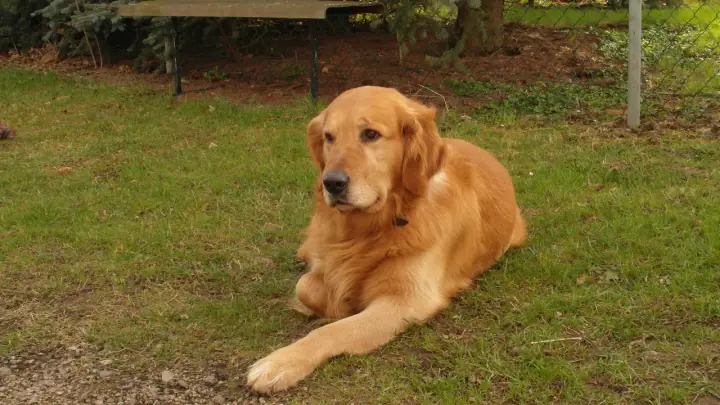
Golden Retrievers have the uncanny ability to joyfully cover your entire wardrobe in fur while convincing you it was your idea all along.
Can a Golden Retriever live in an HDB flat?
NoNot on the HDB approved-breed list
Not on HDB's approved small-breed list, so it cannot be kept in a flat under the standard rules.
HDB sets and maintains the approved-breed list. Check the current rules at HDB.gov.sg →
Full list of HDB-approved breeds on this site →At a glance
- Size category
- Large
- Weight
- 25 to 34 kg
- Height
- 51 to 61 cm
- Lifespan
- 10 to 12 years
- Energy level
- ●●●●○ 4/5 (editorial, unvalidated)
- Shedding
- ●●●●● 5/5 (editorial, unvalidated)
- Heat tolerance
- ●○○○○ 1/5 (editorial, unvalidated)
- Barking
- ●●○○○ 2/5 (editorial, unvalidated)
- Trainability
- ●●●●● 5/5 (editorial, unvalidated)
- Grooming needs
- ●●●●○ 4/5 (editorial, unvalidated)
- Origin
- Scotland (Highland estates, mid 1800s, originally bred to retrieve waterfowl from cold lochs)
Editorial climate-care note
Thick double coat struggles in SG humidity. Prone to heat stress, walk before 8am or after 7pm and skip midday entirely.
This score is not a safe temperature or exercise limit. Any dog can develop heatstroke.
Plan activity around your dog, not a timer
A breed score cannot tell you how many minutes are safe today. Avoid hot conditions, watch your dog's breathing, and agree an activity plan with your vet.
Read PDSA's heatstroke guidance →Common health issues in Singapore's climate
Build a care budget
- Year 1
- S$7,072 to S$9,568
- Over 10 years
- S$65,451 to S$88,551
Illustrative planning assumptions for food, grooming and routine vet care, with inflation and a year-one setup uplift. These are not verified provider quotes or a lifespan prediction. Adjust the calculator to current quotes; add insurance, boarding and emergencies separately.
Run the full lifetime cost calculator →The first thing to settle, before anything else about the breed, is the housing. A Golden Retriever is a 25 to 34 kg dog that grows to roughly 60 cm at the shoulder, and it is not on HDB's list of approved breeds for flats. That is not a loophole question; it is a different animal entirely. If you live in an HDB flat and you want a Golden, the honest answer is to either move to a condo or a landed property that permits the breed, or pick a different dog. The number of Goldens surrendered each year in Singapore because their owners did not check their lease before the puppy arrived is one of the quieter heartbreaks in the local rescue community, and it is preventable.
For the families who do have the right home for one, the Golden Retriever is everything its reputation promises. It is patient with toddlers, gentle in the lift, soft with strangers, trainable to a degree most owners never fully cash in on, and reliably the most photographed member of the family by the end of the first month. The trade-offs are the coat, the heat and the bills, and this guide covers all three.
Personality and temperament
The Golden earned its reputation honestly. This is a soft-mouthed retrieving breed selected for a century and a half to work closely with a person, take direction all day, and carry something delicate back without damaging it. What that produces in a family dog is a temperament with very little edge to it: sociable with strangers, tolerant of clumsy handling from children, generally easy with other dogs at the void deck or in the lift, and happiest when there is a person in the room.
The parts that surprise new owners are worth saying plainly.
- It stays a puppy for a long time. Goldens mature slowly, and a physically adult dog of 30 kg can still be mentally adolescent at eighteen months. That combination, big body and puppy brain, is the source of most of the "he is out of control" calls trainers get about the breed.
- It does not like being alone. A dog bred to work alongside someone all day does not switch that off in a flat. Goldens are among the more separation-prone breeds, and a household where everyone leaves at eight and returns at seven needs a real plan, not good intentions.
- It puts things in its mouth. The retrieving instinct comes with an oral habit. Puppy-proofing matters more than usual, and so does giving the dog something legitimate to carry.
- It is not a guard dog. Barking level on this page is rated 2 out of 5, and the breed's usual response to a stranger at the gate is delight. If you want a dog that deters, this is not it.
A Golden is not a low-maintenance dog. It is an easy dog to live with and a demanding dog to look after, and those are different things.
Exercise in Singapore's climate
The daily picture of a Golden in Singapore is shaped by one fact above all others: this is a breed developed to retrieve waterfowl from cold Scottish lochs, with a dense double coat designed for North Atlantic weather. Transplanted into 30 degree humidity, that coat insulates a dog that cannot sweat through its skin and is not famously good at self-limiting. Heat management is not a seasonal concern here. It is the daily operating system of owning the breed.
Singapore's daily minimum temperature is usually 23 to 25 degrees Celsius overnight, climbing to a daily maximum of 31 to 33 degrees by afternoon, and average relative humidity sits around 82% year-round (Meteorological Service Singapore). There is no cool season to plan around. This page rates the Golden's heat tolerance at 1 out of 5, the lowest band we use.
In practice that means walks before 7am and after 7.30pm, on grass or shaded park surfaces wherever possible. Tarmac at 11am will burn paw pads and trap heat against the dog's body within minutes. Carry water on every walk, take regular shade breaks, and learn the early signs of heat distress: panting that does not settle, thick or stringy saliva, a wobbly gait, or a dog that lies down and will not get up. Any of those means shade and water immediately, not one more block. Heat stroke in Goldens in Singapore is not rare, and local emergency vets see it through the year, almost always in the hour or two after an owner decided a midday walk would be fine for once.
The volume of exercise is real but not extreme. A 45 minute morning walk, an evening walk of similar length, and indoor fetch or chew time covers it for most adult Goldens, with a longer weekend outing (West Coast Park, the Bishan-Ang Mo Kio park connector, or Sembawang Hot Spring Park early in the morning) to round out the week. Mental work matters as much as physical. Goldens are some of the easiest dogs in the world to train, which makes scent games, recall practice and basic obedience a pleasure rather than a chore, and thirty minutes of nosework in an air-conditioned living room does more for a hot afternoon than a walk you should not be taking.
Coat and grooming in the humidity
The double coat is not a styling choice, it is the dog's thermal system, and it needs handling rather than removing. A full groom every 6 to 8 weeks at S$120 to S$200 is the usual rhythm, with weekly brushing at home as the part that actually does the work. The coat blows twice a year, although in Singapore's stable humidity the shed pattern is closer to a constant low-level snowfall onto every dark surface in the flat. Robot vacuums earn their keep.
A summer cut is not advisable. The double coat regulates heat as well as cold, and shaving it disrupts that, exposes skin that has never seen direct sun, and can grow back patchy. The right answer to a hot dog is not less coat, it is a well-brushed coat with no dead undercoat trapped in it, plus shade, water and air conditioning.
Two humidity-specific jobs matter more here than in a temperate climate:
- Dry the dog properly. A double coat that stays damp near the skin is a hot spot waiting to happen. After a bath, a swim or heavy rain, dry down to the skin rather than towelling the surface.
- Check the ears every week. Drop ears over a damp coat are a standing invitation to infection, and ear infections are on this page's health-issue list for the breed. A quick look and a dry wipe after water is two minutes well spent.
Diet and feeding
Food sits at roughly S$180 to S$240 a month for a decent large-breed kibble or a fresh-food rotation. The breed is prone to weight gain, and an overweight Golden in this climate is a dog in measurable distress, not just a rounder dog. Portion control is part of the deal from day one, and the portion should come from your vet or a feeding guide matched to your individual dog's weight and activity, not from a breed average.
The climate changes some practical details even though it does not change the nutrition. Dry kibble left out in a humid Singapore kitchen absorbs moisture and can spoil or attract pests faster than the same food would in a drier climate, so store it sealed and out of direct heat, and do not leave a bowl standing all day. Fresh water needs to be available at all times, and in this heat that means checking and refilling more often than a food label would suggest, because a dog panting in humidity loses more fluid than one in a temperate climate.
The Golden is a large, deep-chested breed, and deep chest conformation is a recognised risk factor for gastric dilatation-volvulus (bloat), a rapidly progressive and life-threatening emergency according to the American College of Veterinary Surgeons. The usual precautions apply: two or more smaller meals through the day rather than one large one, no vigorous exercise for a period either side of eating, and no abrupt food changes. These are general precautions for large deep-chested dogs rather than Golden-specific rules, and they are worth raising with your vet directly rather than treating as a substitute for veterinary advice.
Training
This page rates trainability at 5 out of 5, and that is not flattery. The Golden is one of the most biddable breeds there is: quick to learn, strongly motivated by food and by your attention, and genuinely willing. Most owners never use more than a fraction of what the dog is capable of.
What makes training go wrong with the breed is almost never the dog's ability. It is timing. The slow maturity means the window where a 15 kg adolescent is easy to handle closes before the dog is mentally grown up, so the lead manners, the settle, the recall and the "leave it" all need to be solid before the dog is strong enough to make the argument physically. Loose-lead walking in particular is worth over-investing in early: a 30 kg dog that pulls is a different daily experience from a 30 kg dog that does not, especially in a lift lobby or a crowded park connector.
Two other things are worth building deliberately, because neither happens on its own:
- Time alone. Build it up in small pieces from puppyhood rather than discovering the problem when you go back to the office. A Golden that has never practised being alone does not learn it easily at three.
- Calm indoors. In a climate where a good chunk of the day has to be spent inside, a dog with an off switch is worth more than a dog with a big vocabulary. Reward settling as deliberately as you reward sitting.
Health
This is the section to read carefully before you commit, because the Golden's health profile is the least comfortable part of the breed and the part most often glossed over at the point of sale.
The UK Kennel Club lists, as good practice before breeding a Golden Retriever, a DNA test for progressive retinal atrophy (GR_PRA2), elbow testing under the BVA/KC Elbow Dysplasia Scheme, eye testing and gonioscopy for PLA under the BVA/KC/ISDS Eye Scheme, and hip testing under the BVA/KC Hip Dysplasia Scheme, with DNA tests for ichthyosis (ICT-A) and a second form of progressive retinal atrophy (GR_PRA1) as best practice on top. That list is a fair map of the breed's inherited risks: joints and eyes, plus a skin condition.
Cancer sits alongside those. The Morris Animal Foundation's Golden Retriever Lifetime Study has followed thousands of Goldens through their lives specifically because the breed's cancer rates are high enough to warrant it. Prospective owners should read the breed honestly on that front rather than hear it for the first time from a vet in year eight.
In Singapore specifically, add the tropical layer. Skin and ear infections are close to universal at some point in a Golden's life here, and recurrent cases push the annual vet bill up meaningfully. This page's own health-issue flags for the breed are joint and mobility problems, heart conditions, allergies, weight management and ear infections, which lines up with both the inherited picture and the climate one.
What that means practically:
- Ask for hip and elbow clearances on both parents, in writing, plus a current cardiac evaluation and eye certification. A breeder who treats orthopaedic paperwork as optional is not a breeder to work with at any price.
- Budget annual orthopaedic checks from about age three.
- Treat dermatology as a baseline budget line rather than a surprise.
- Arrange pet insurance in the first months of ownership, before anything has presented. With this breed that is the difference between a difficult decision and a financially impossible one.
None of this replaces a vet's assessment of your individual dog.
Housing and space in Singapore
The Golden is not an HDB dog, and no amount of good behaviour changes that. HDB sets and maintains the approved-breed list and the size limits for flats, and a 25 to 34 kg dog at around 60 cm is outside them. Check the current rules directly with HDB before making any plans around a specific home. In practice this breed belongs in a condominium or landed property that permits it, and condominium by-laws vary by development, so read the actual rules for the actual block rather than assuming private property means yes.
Ownership limits are a separate question and come from AVS rather than HDB. Under AVS's rules, an HDB flat may keep a maximum of one dog of an approved small breed plus up to two cats, and no dog on the Specified dogs list; private property may keep up to three cats or dogs in combination. Every dog in Singapore also needs an AVS licence. Licence fees depend on sterilisation status, age and the number of pets. One-time and three-year licences are different options. Check the current AVS fee table before paying.
Inside the home, what the breed actually needs is less about floor area than about temperature and surface. A cool room, a tile floor or a cool mat, air conditioning during the hottest part of the day, and somewhere out of the sun. The dog will find the coolest room in the house on its own and stay there; the useful thing you can do is make sure that room is one it is allowed in.
Care and cost in Singapore
Plan for S$6,500 to S$9,500 in year one and S$6,500 to S$8,500 a year ongoing. The Golden is not a cheap dog to keep well here, and the bills cluster into three predictable categories: food at S$180 to S$240 a month, grooming at S$120 to S$200 every 6 to 8 weeks plus home brushing, and veterinary care.
Veterinary care is where Golden ownership gets expensive. Routine visits, vaccinations, heartworm prevention, dental work and a basic blood panel land at S$1,200 to S$1,800 a year before anything goes wrong, and the breed's predispositions mean things do go wrong often enough to plan for. You can run the full ten-year picture for your own situation with the cost calculator.
Getting a Golden Retriever: buying and adoption
If you are buying, insist on the breeder's AVS dog farm licence number, PennHIP or OFA hip clearance and OFA elbow clearance on both parents, a current cardiac evaluation, eye certification from a board-certified ophthalmologist, and a written 24-month health guarantee covering hip, elbow and major hereditary conditions. Ask whether the breeder screens for ichthyosis and for the NCL form found in some Golden lines. A responsible breeder answers these specifically and shows you paperwork rather than describing the parents in general terms.
Adoption is unusually realistic for this breed in Singapore, and it is worth checking seriously rather than treating as a fallback. The mismatch between Golden expectations and Singapore housing realities means Goldens and Golden crosses come through the rescue network regularly, often after a first home discovered the housing rules or the medical bills. SOSD and Causes for Animals both rehome them. A Golden cross that meets the size criteria can also route through Project ADORE at AVS, though pure Goldens generally do not. An adult rescue also comes with a visible adult size, coat and temperament rather than the uncertainty of a puppy.
The thing not to do is import a puppy from a social media listing in Malaysia, Indonesia or further afield. The price difference is real and so is the absence of orthopaedic clearance on the parents, which becomes a hip surgery bill in year four.
Life stages: puppy to senior
Puppy, to about 12 months. The joints are the priority. Large-breed puppies should not be doing forced or repetitive exercise on hard surfaces while the growth plates are open, so keep walks short and frequent rather than long, and let play be self-paced. This is also the window for socialisation and for teaching time alone, both of which are far harder to install later. Feed a large-breed puppy formulation and resist the urge to grow the dog fast.
Adolescent, roughly 12 to 24 months. Full size, unfinished brain. Recall gets less reliable, lead manners slip, and the dog is now strong enough to make its opinion felt. Consistency through this phase matters more than anything you did before it, and escalating pressure does not help a soft breed. This is when most Goldens get labelled difficult, and almost none of them are.
Adult, roughly 2 to 7 years. The easy years, and the right ones for building habits that pay off later: a stable weight, annual orthopaedic checks from about three, a grooming rhythm that stays ahead of the coat rather than catching up with it, and an insurance policy already in force.
Senior, from about 8 years. Golden lifespan on this page is 10 to 12 years, which is short, and the last stretch tends to be where the breed's health profile shows up. Move to twice-yearly vet visits, watch for lumps and report them promptly rather than watching them, expect stiffness in the mornings, and adjust the walk to the dog rather than the calendar. Heat tolerance drops further with age, so the summer routine you built at three needs to get stricter at ten. This is also the stage to think about what good care looks like for your dog specifically, and to have that conversation with your vet before you are having it in an emergency.
See dog-friendly cafes and parks in your region → | Run the 10-year cost of a Golden Retriever in Singapore →
Three things to know
-
Housing comes before anything else
A Golden Retriever does not fit in an HDB flat by law, and a condo or landed property with permission for the breed is the prerequisite, not a detail. Sort the housing first or pick a different breed.
-
Heat is the daily operating system
Walks before 7am and after 7.30pm, water on every outing, cool surfaces at home, and a low threshold for the air conditioning. The breed will not self-limit, so the household has to.
-
Plan the medical bills for what they actually are
Hip and elbow screening on the parents, annual orthopaedic checks from age three, dermatology as a baseline budget line, and pet insurance arranged before any condition presents. The Golden cancer rate is real, and the kind preparation is financial.
Annual cost in Singapore
Editable planning estimates, not verified provider quotes or a prediction of your dog's bills. Boarding, one-off equipment and emergencies are additional.
- Food
- S$2,400
- Grooming
- S$1,800
- Routine vet
- S$2,200
- Sum of the three
- S$6,400/year
Run the lifetime cost calculator →
Get a current insurance quote for your dog's age and circumstances. Compare exclusions, waiting periods, excess and cover limits. Compare policy questions here →
Frequently asked questions
Is a Golden Retriever HDB-approved in Singapore?
No. The Golden Retriever is not on the HDB approved-breed list, so under current rules it cannot be kept in an HDB flat. It may still suit private housing. Always check the latest HDB and AVS guidance.
Do Golden Retrievers bark a lot?
Our current barking assessment is: is fairly quiet (editorial estimate). It has not been independently validated. Ask about this dog's observed behaviour, triggers and time alone; the breed label cannot predict your neighbour's experience.
How much grooming does a Golden Retriever need?
Our current grooming assessment is: is high-maintenance to groom (editorial estimate). Confirm the individual coat-care routine and any professional grooming with the rescue, groomer or vet. The score is not a measured frequency or price.
How does a Golden Retriever cope with Singapore's heat?
An editorial heat score cannot establish a safe temperature or walk duration for an individual dog. Activity, humidity, health, age and body shape matter. Avoid hot conditions, provide shade and water, and ask your vet about an appropriate activity plan.
Is a Golden Retriever a good breed for a first-time owner?
Our household-fit note is: Editorial: may suit. This is not a validated prediction. Assess the individual dog, your daily capacity, training support and known care needs before deciding.
How much does a Golden Retriever cost to keep in Singapore?
The stored planning assumption is S$6,400 a year for food, grooming and routine veterinary care. It is not a verified typical cost for this breed. Replace it with current quotes and your own usage; add setup, licensing, insurance if chosen, boarding and emergency savings separately.
Other large breeds to consider

A Golden Retriever in Singapore, the short version
A Golden Retriever isn't HDB-approved, so life in a flat isn't the standard route here. It suits landed housing or a spacious condo with a garden or nearby green space far better. Singapore's humidity is the real challenge: that thick double coat was built for cooler climates, and it'll pant hard on anything but an early or late walk. Regular grooming cuts down on shedding and helps it shed heat too. Given its size and exercise needs, this is a breed for owners with outdoor access and time for two solid walks a day, not a dog that thrives in a small, air-conditioned unit alone for long hours.
Golden Retriever vs...
Deciding between two breeds? See them side by side.
Find Golden Retriever-friendly spots in Singapore
High-energy breed, so these outdoor venues give Golden Retrievers the space they need.
 Breed fit quiz Does a Golden Retriever actually suit your life? Answer a few questions about your lifestyle and see how well this breed matches your real setup. Find out →