
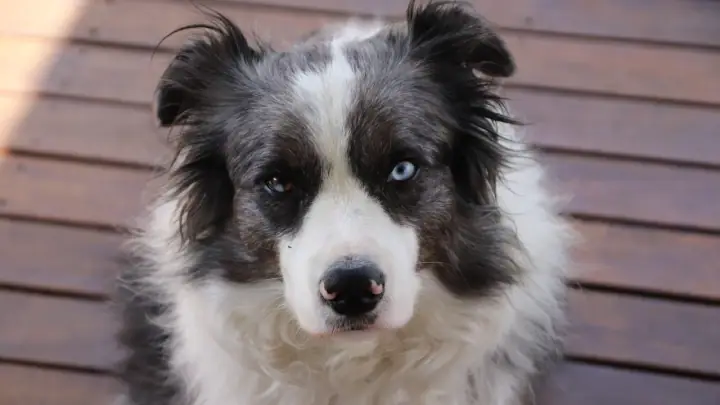
DOG BREED GUIDE · CONDO & LANDED HOMES
Last updated First published 31 May 2026
Notice one little habit together →A small idea to try, with progress kept in your Pack.
Also known as Collie (working), Sheepdog.
Thinking about adopting a Border Collie?
A Border Collie may keep an eye on all your neighbours' comings and goings, which is only problematic when it tries to organise everyone into an orderly queue at the lift.
Can a Border Collie live in an HDB flat?
NoNot on the HDB approved-breed list
Not on HDB's approved small-breed list, so it cannot be kept in a flat under the standard rules.
HDB sets and maintains the approved-breed list. Check the current rules at HDB.gov.sg →
Full list of HDB-approved breeds on this site →At a glance
- Size category
- Large
- Weight
- 12 to 20 kg
- Height
- 46 to 56 cm
- Lifespan
- 12 to 15 years
- Energy level
- ●●●●● 5/5 (editorial, unvalidated)
- Shedding
- ●●●●○ 4/5 (editorial, unvalidated)
- Heat tolerance
- ●●○○○ 2/5 (editorial, unvalidated)
- Barking
- ●●●○○ 3/5 (editorial, unvalidated)
- Trainability
- ●●●●● 5/5 (editorial, unvalidated)
- Grooming needs
- ●●●○○ 3/5 (editorial, unvalidated)
- Origin
- Anglo-Scottish border region (working sheepdog refined over centuries, formalised as a breed in the 19th century)
Editorial climate-care note
Working coat built for cooler climates. High exercise needs mean careful timing is essential to avoid overheating in SG.
This score is not a safe temperature or exercise limit. Any dog can develop heatstroke.
Plan activity around your dog, not a timer
A breed score cannot tell you how many minutes are safe today. Avoid hot conditions, watch your dog's breathing, and agree an activity plan with your vet.
Read PDSA's heatstroke guidance →Common health issues in Singapore's climate
Build a care budget
- Year 1
- S$4,752 to S$6,428
- Over 10 years
- S$43,975 to S$59,495
Illustrative planning assumptions for food, grooming and routine vet care, with inflation and a year-one setup uplift. These are not verified provider quotes or a lifespan prediction. Adjust the calculator to current quotes; add insurance, boarding and emergencies separately.
Run the full lifetime cost calculator →The Border Collie is the most intelligent dog breed in the world by most reckonings, and in Singapore that is closer to a warning than a recommendation. This page rates trainability 5 out of 5 and energy 5 out of 5, and pairs them with heat tolerance 2 out of 5 and a note that the breed is not suited to apartment living.
It is also not on HDB's approved list, so for most Singapore households the housing question settles it before the temperament one arises. For the households where it does not, this guide is about what a working dog actually needs, and about the longest screening list on this site.
Personality and temperament
Border Collies were bred to work sheep at distance, all day, making their own decisions and reading tiny signals from a handler across a hillside. Everything about the modern dog follows from that.
Trainability at 5 out of 5 undersells it. This is a dog that learns things you did not intend to teach, notices patterns you did not know you had, and will have worked out your morning routine by the end of its first week. It is rated good with children and good with other dogs, and beginner friendliness is rated low, which is the honest counterweight.
The herding instinct does not switch off in a living room. It shows up as watching, stalking, circling, and sometimes nipping at heels, most often with running children or cyclists. That is not aggression, it is the breed doing its job on the only moving objects available, and it needs redirecting into legitimate work rather than punishing.
Barking is rated 3 out of 5, moderate, and it climbs sharply in an under-occupied dog.
Exercise in Singapore's climate
Energy 5 out of 5 against heat tolerance 2 out of 5 is one of the hardest combinations on this site to serve honestly.
The double coat was built for the Anglo-Scottish borders, and Singapore's daily maximum of 31 to 33 degrees Celsius with average relative humidity around 82% year round (Meteorological Service Singapore) gives it very little room to shed heat. Meanwhile the dog wants to work.
The physical side has to happen in the cool hours: an hour or more, split, before 7am and after 8pm, on grass and shade. Swimming, where you can get it, is the most efficient exercise available to a heavily coated dog here.
The part that actually keeps a Border Collie sane is the mental work, and in this climate it is not a supplement, it is the majority of the job. Teach it a large vocabulary of named toys. Run scent trails through the house. Use a flirt pole in the cool of the evening. Teach tidying-up, or trick chains, or the names of family members. Twenty minutes of genuine thinking tires this breed more than an hour of walking, and it can be done at two in the afternoon when going outside would be irresponsible.
A Border Collie that is under-worked does not mope. It invents a job, and the jobs it invents are things like patrolling, obsessive shadow-chasing, light-fixation and door-guarding, several of which are genuinely hard to reverse once established. Singapore veterinary behaviourists see the results.
Coat and grooming in the humidity
Grooming needs are rated 3 out of 5 at about S$900 a year, and shedding 4 out of 5. The double coat sheds substantially and continuously here, and then more so when the undercoat releases.
Brush thoroughly two or three times a week, right down to the skin, because removing dead undercoat is what actually helps the dog cool. A slicker plus an undercoat rake does most of the work.
Do not shave it. A double coat insulates in both directions and protects skin from a high UV index, and shaved double coats frequently grow back patchy and coarser. Take the dead coat out instead.
Dry thoroughly after swimming and rain, and check behind the ears and in the ruff, where damp sits longest in this humidity.
Diet and feeding
Food runs about S$1,600 a year. Weight management is on this page's health-issue list, and on a working breed with joint mobility also listed, keeping the dog lean is orthopaedic care rather than aesthetics.
Weigh the food and count training treats inside the daily total, which on a dog you should be training this much is a real quantity. Use the dog's own kibble as the training currency wherever you can.
Grow puppies slowly and do not over-exercise a developing joint on hard ground, particularly in the heat where a young dog will push past sense to keep working with you.
Training
With a 5 out of 5 dog the question is never whether you can teach it, but whether you are teaching it deliberately. Priorities:
- An off switch, taught explicitly. A settle on a mat, rewarded heavily, practised daily. This breed does not develop one on its own and a dog that cannot stop is a dog that burns out its household.
- Redirect the herding early. Give it a legitimate outlet, a ball, a toy, a trick sequence, the moment the watching starts, rather than waiting for the nipping.
- Recall to a whistle. Achievable to an extremely high standard in this breed and worth having.
- Vary the work. A Border Collie that does the same three tricks for a decade gets bored of them. Keep introducing new things; it is genuinely one of the pleasures of the breed.
Health
The UK Kennel Club carries one of the longest recommended lists on this site for the Border Collie: eye testing including gonioscopy for PLA using the BVA/KC/ISDS Eye Scheme, hip testing using the BVA/KC Hip Dysplasia Scheme, elbow testing using the BVA/KC Elbow Dysplasia Scheme, and hearing testing for deafness using the KC BAER Scheme, including litter screening. It also lists DNA tests for collie eye anomaly and choroidal hypoplasia (CEA/CH), ceroid lipofuscinosis, Imerslund-Gräsbeck syndrome (IGS), multi-drug resistance (MDR1), trapped neutrophil syndrome (TNS), sensory neuropathy (SN), and severe goniodysgenesis and glaucoma risk (GGD). It places the breed in Breed Watch Category 1, and states that "currently no points of concern specific to this breed have been identified for special attention by judges, other than those covered routinely by The Kennel Club's breed standard".
That is a formidable list, and the right way to read it is as good news: every named test is a solved problem a responsible breeder can simply avoid producing. Ask for all of them, plus the hip, elbow, eye and BAER paperwork, on both parents. Documents with the dogs' names on them.
Two deserve pulling out.
MDR1 is the one that protects your dog at an emergency clinic at two in the morning. It is a mutation affecting how a dog processes certain common drugs, and an affected dog can react severely to doses that are routine for other breeds. This is not a breeding footnote. Test the dog, write the result on its records, put it in your phone, and tell any vet before they prescribe anything. On this breed that single piece of paper is worth more than most of the rest.
BAER hearing testing including litter screening means the whole litter can be tested, not just the parents, so a result exists for your specific puppy. A unilaterally deaf dog lives a completely normal life with an owner who knows, and a confusing one with an owner who was never told and concludes the dog is being difficult.
This page's own list is short: joint mobility, eye conditions and weight management, with routine veterinary care at about S$1,800 a year. Arrange insurance in the first weeks, before any joint or eye note is on record to be written back as an exclusion. None of this replaces your own vet's assessment of your own dog.
Housing and space in Singapore
The Border Collie is not on HDB's published list of approved breeds for flats, which names 61 breeds plus a cross of any two of them. There is no size to come in under, because the list names breeds rather than setting a test. This page also rates the breed as not apartment suitable, which is a separate judgement about the dog rather than about the rules, and the two happen to agree.
Ownership limits come from AVS rather than HDB. Under AVS's rules, an HDB flat may keep a maximum of one dog of an approved small breed plus up to two cats, and no dog on the Specified dogs list; private property may keep up to three cats or dogs in combination. Every dog needs an AVS licence. Licence fees depend on sterilisation status, age and the number of pets. One-time and three-year licences are different options. Check the current AVS fee table before paying.
What this dog needs from a home is less about floor area than about access and stimulation: a straightforward route out several times a day including late at night, somewhere within reach where it can genuinely run off-lead, air-conditioning or reliable cooling for the middle of the day, and a household that is around enough to keep it occupied.
Care and cost in Singapore
On this page's figures: about S$1,600 a year for food, S$900 for grooming and S$1,800 for routine veterinary care. The number that does not appear in that total is your time, and on this breed it is the largest line by a distance. Run the ten-year picture with the cost calculator.
Getting a Border Collie: buying and adoption
Ask for the AVS dog farm licence number, then work through the list above by name: hip and elbow scores, eye certificates with gonioscopy, the litter's BAER results, and the DNA panel including MDR1. A breeder doing this properly will hand it over unprompted, because assembling it is the hard part of their job.
Ask what the parents do. Working lines are more driven than show lines, and in a climate that caps outdoor exercise, more drive is more of a problem to solve indoors. Be honest with the breeder about your setup and let them tell you if it is wrong.
Adoption is genuinely worth pursuing here. Border Collies and Collie crosses come through SOSD, Causes for Animals and Mercylight, usually as adolescents between one and three, which is exactly when families discover what 5 out of 5 energy means in a tropical city. Those dogs are typically sound and simply under-employed. An adult also arrives with its drive level visible rather than hoped for.
What to skip: any seller who describes this breed as adaptable to apartment living.
Life stages: puppy to senior
Puppy, to about 12 months. Confirm the MDR1 result and record it somewhere you will find it in an emergency. Confirm the BAER result. Grow the dog slowly, keep it lean, and resist over-exercising the joints. Teach the settle from week ten, before the engine arrives. Insurance in force early.
Adolescent, roughly 9 to 24 months. The demanding stretch. Full drive, no judgement, and a strong interest in inventing work. Herding behaviours, obsessive patterns and barking all appear here if the mental work has lapsed. Increase the thinking, not the distance, because the climate has not changed.
Adult, roughly 2 to 8 years. A superb dog when the routine holds. Daily thinking, cool-hour exercise, swimming where possible, coat brushed, weight held.
Senior, from about 9 years. Lifespan here is 12 to 15 years. Move to twice-yearly vet visits. Watch for stiffness rising and shortening stride, and raise it rather than filing it under age, since joint pain is treatable. Eyes deserve attention given the screening list. The brain outlasts the body in this breed by years, so keep giving it work at a gentler pace rather than retiring it, which it will not enjoy.
See dog-friendly cafes and parks in your region → | Run the 10-year cost of a Border Collie in Singapore →
Three things to know
-
Test for MDR1 and carry the result
It changes how the dog reacts to common drugs, and it is the piece of paper that protects it at an emergency clinic at 2am. Ask for it by name alongside the other DNA tests and the BAER litter result.
-
Energy 5 out of 5 against heat tolerance 2 out of 5
The physical half has to happen before 7am and after 8pm, so the mental half becomes the majority of the work. Twenty minutes of real thinking beats an hour of walking, and it can happen indoors at midday.
-
It cannot live in an HDB flat, and this page also rates it not apartment suitable
The rules and the dog agree for once. Plan for a home near somewhere it can actually run.
Annual cost in Singapore
Editable planning estimates, not verified provider quotes or a prediction of your dog's bills. Boarding, one-off equipment and emergencies are additional.
- Food
- S$1,600
- Grooming
- S$900
- Routine vet
- S$1,800
- Sum of the three
- S$4,300/year
Run the lifetime cost calculator →
Get a current insurance quote for your dog's age and circumstances. Compare exclusions, waiting periods, excess and cover limits. Compare policy questions here →
Frequently asked questions
Is a Border Collie HDB-approved in Singapore?
No. The Border Collie is not on the HDB approved-breed list, so under current rules it cannot be kept in an HDB flat. It may still suit private housing. Always check the latest HDB and AVS guidance.
Do Border Collies bark a lot?
Our current barking assessment is: has a moderate bark (editorial estimate). It has not been independently validated. Ask about this dog's observed behaviour, triggers and time alone; the breed label cannot predict your neighbour's experience.
How much grooming does a Border Collie need?
Our current grooming assessment is: needs moderate grooming (editorial estimate). Confirm the individual coat-care routine and any professional grooming with the rescue, groomer or vet. The score is not a measured frequency or price.
How does a Border Collie cope with Singapore's heat?
An editorial heat score cannot establish a safe temperature or walk duration for an individual dog. Activity, humidity, health, age and body shape matter. Avoid hot conditions, provide shade and water, and ask your vet about an appropriate activity plan.
Is a Border Collie a good breed for a first-time owner?
Our household-fit note is: Editorial: may need more support. This is not a validated prediction. Assess the individual dog, your daily capacity, training support and known care needs before deciding.
How much does a Border Collie cost to keep in Singapore?
The stored planning assumption is S$4,300 a year for food, grooming and routine veterinary care. It is not a verified typical cost for this breed. Replace it with current quotes and your own usage; add setup, licensing, insurance if chosen, boarding and emergency savings separately.
Other large breeds to consider


A Border Collie in Singapore, the short version
A Border Collie isn't HDB-approved, and its working-dog energy level means a flat would be a poor fit even if it were. This breed needs serious daily physical and mental exercise, herding instinct doesn't switch off just because there are no sheep, and under-stimulation shows up as anxiety or destructive behaviour quickly. Its coat suits cooler climates better than Singapore's humidity, so exercise needs to be timed carefully around the coolest hours. Landed housing with real space, or a very committed owner with access to large open areas, is close to a minimum requirement. This is one of the more demanding breeds on this list to keep well in Singapore.
Border Collie vs...
Deciding between two breeds? See them side by side.
Find Border Collie-friendly spots in Singapore
High-energy breed, so these outdoor venues give Border Collies the space they need.
 Breed fit quiz Does a Border Collie actually suit your life? Answer a few questions about your lifestyle and see how well this breed matches your real setup. Find out →