
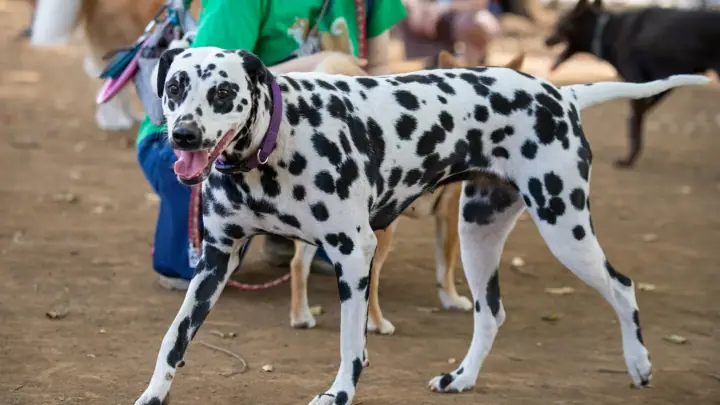
DOG BREED GUIDE · CONDO & LANDED HOMES
Last updated First published 31 May 2026
Notice one little habit together →A small idea to try, with progress kept in your Pack.
Also known as Carriage Dog, Spotted Coach Dog, Firehouse Dog.
Thinking about adopting a Dalmatian?
A Dalmatian will spot every breadcrumb in your home with the same intensity it once eyed potential threats to horse-drawn carriages.
Can a Dalmatian live in an HDB flat?
NoNot on the HDB approved-breed list
Not on HDB's approved small-breed list, so it cannot be kept in a flat under the standard rules.
HDB sets and maintains the approved-breed list. Check the current rules at HDB.gov.sg →
Full list of HDB-approved breeds on this site →At a glance
- Size category
- Large
- Weight
- 16 to 32 kg
- Height
- 48 to 61 cm
- Lifespan
- 11 to 13 years
- Energy level
- ●●●●● 5/5 (editorial, unvalidated)
- Shedding
- ●●●●○ 4/5 (editorial, unvalidated)
- Heat tolerance
- ●●●○○ 3/5 (editorial, unvalidated)
- Barking
- ●●○○○ 2/5 (editorial, unvalidated)
- Trainability
- ●●●○○ 3/5 (editorial, unvalidated)
- Grooming needs
- ●●○○○ 2/5 (editorial, unvalidated)
- Origin
- Croatia (Dalmatia region, working coach dog for centuries, formally standardised in the late 1800s)
Editorial climate-care note
Short coat helps, but the breed's high energy means it still overheats on long midday runs.
This score is not a safe temperature or exercise limit. Any dog can develop heatstroke.
Plan activity around your dog, not a timer
A breed score cannot tell you how many minutes are safe today. Avoid hot conditions, watch your dog's breathing, and agree an activity plan with your vet.
Read PDSA's heatstroke guidance →Common health issues in Singapore's climate
Build a care budget
- Year 1
- S$5,083 to S$6,877
- Over 10 years
- S$47,043 to S$63,646
Illustrative planning assumptions for food, grooming and routine vet care, with inflation and a year-one setup uplift. These are not verified provider quotes or a lifespan prediction. Adjust the calculator to current quotes; add insurance, boarding and emergencies separately.
Run the full lifetime cost calculator →Two facts decide whether a Dalmatian works in Singapore, and neither of them is the one people arrive with. The first is that this dog cannot legally live in an HDB flat. The second is that it has a kidney chemistry unlike any other breed, which turns a hot climate and a slightly under-watered dog into a surgical problem.
Get both of those right and you have an athletic, funny, deeply engaged companion for eleven to thirteen years. Get the second one wrong and you will meet your vet more often than you would like.
Personality and temperament
Energy is rated 5 out of 5, the top of the scale, and everything else about living with this breed follows from that number. The Dalmatian was bred to trot alongside horses for miles, and it retained the engine long after the job disappeared. Beginner friendliness is rated low here, and that is not about temperament. It is about stamina.
Barking is rated 2 out of 5, which is genuinely low, and it is rated good with children and good with other dogs. This is a sociable, people-oriented breed that does badly in isolation and well in a busy household.
Trainability is rated 3 out of 5, which understates the intelligence and captures the attitude. A Dalmatian knows what you want. Whether it agrees depends on whether it has had enough exercise, which brings us back to the number at the top.
Exercise in Singapore's climate
Heat tolerance is rated 3 out of 5, which is better than most large breeds on this site, and the short coat is why. It is also the number most likely to get a Dalmatian into trouble, because moderate heat tolerance combined with maximum energy produces a dog that will keep going well past the point where it should have stopped.
Singapore runs a daily maximum of 31 to 33 degrees Celsius with average relative humidity around 82% year round (Meteorological Service Singapore). A Dalmatian needs sixty to ninety minutes of real exercise a day, and all of it has to be before 8am or after 8pm.
The thing that makes this breed genuinely demanding here is that a walk does not satisfy it. This is a trotting breed. It wants distance and rhythm. Practical outlets in Singapore: long early park connector runs if you run, a bicycle if you are confident and the dog is trained to it, off-lead time in a fenced dog run, and swimming. Scent work and training fill the gaps but they do not replace the miles.
Carry water on every outing without exception. The reason is not general good practice, it is specific to this breed, and the health section explains why.
Coat and grooming in the humidity
Grooming needs are rated 2 out of 5 at about S$600 a year, and shedding is rated 4 out of 5. That combination catches people out. The Dalmatian's coat needs almost no professional attention and sheds constantly, in short stiff white hairs that weave themselves into upholstery and are genuinely difficult to remove. If you are house-proud, know this before you commit rather than after.
A rubber curry mitt two or three times a week takes out a remarkable amount and is most of the job. Itchy skin is one of only two health issues listed on this page, so use a gentle shampoo, rinse thoroughly, and dry the dog properly rather than letting it air-dry in humidity.
One climate note the short coat creates: pale skin under thin white hair burns. A Dalmatian resting in direct sun on a balcony is not as protected as a darker dog would be, so give it shade rather than assuming the coat is doing the work.
Diet and feeding
This is the most important feeding section on this site, and it is worth reading even if you skip the others.
Food runs about S$1,800 a year. The Dalmatian metabolises purines differently from every other dog breed, excreting uric acid rather than converting it further, and that uric acid can crystallise into urate stones in the urinary tract. Urinary issues are the first health issue listed on this page and this is why.
Three things follow, and all three are Singapore-specific in their intensity:
- Water is medical, not optional. Concentrated urine is what lets crystals form. In a climate where a dog loses fluid all day, keeping a Dalmatian genuinely well hydrated is the single most effective thing you can do for its long-term health. Multiple water bowls, refreshed often, water on every walk, and wet food or water added to kibble if the dog is a reluctant drinker.
- Purine load matters. Organ meat, and some fish and game, are high in purines. Talk to your vet about the right diet for your individual dog rather than choosing on marketing, and be sceptical of high-protein novelty foods.
- Never let a Dalmatian hold on. A dog that cannot urinate when it needs to is a dog holding concentrated urine longer. Frequent opportunities out matter more for this breed than for almost any other.
Learn the signs of a urinary obstruction and treat them as an emergency: straining, producing little or nothing, blood in the urine, licking at the genitals, or restlessness and discomfort. A blocked male dog is a life-threatening emergency and hours matter.
Training
The training brief is shaped by the energy rating. A well-exercised Dalmatian is a pleasant, biddable dog. An under-exercised one is where the breed's reputation for being difficult comes from.
- Loose-lead walking, early and thoroughly. This dog reaches 16 to 32 kg and was built to pull forward at a steady trot for hours. Fix this while it is a puppy.
- Recall, worked hard. The off-lead time this breed needs is only available to a dog whose recall you trust.
- A settle. A high-energy dog that has never learned an off switch does not develop one on its own.
- Handling for the vet. Given the urinary picture, this dog will be examined and possibly catheterised at some point. Make being handled unremarkable.
Health
The UK Kennel Club recommends four screening measures for the Dalmatian: a DNA test for hyperuricosuria (HUU), hip testing using the BVA/KC Hip Dysplasia Scheme, elbow testing using the BVA/KC Elbow Dysplasia Scheme, and hearing testing for deafness using the KC BAER Scheme, including litter screening. It also records a test recognised in October 2025 for disproportional dwarfism (DD-PRKG2). The breed sits in Breed Watch Category 1, where the Kennel Club records no points of concern identified for special attention by judges.
Two of those four are the whole buying conversation.
Hyperuricosuria is the genetic basis of the urate stone problem described above. A DNA test exists, it is recommended by name, and it tells you what you are dealing with before you commit. Ask for both parents' HUU results.
Deafness is the one people do not know to ask about, and the Kennel Club recommendation is specific: BAER hearing testing, including litter screening. That means the whole litter, not just the parents. Congenital deafness is associated with the pigmentation genetics that produce the coat, which is why the breed has a scheme for it at all. A BAER result tells you whether a puppy is hearing in both ears, one, or neither. A unilaterally deaf dog can live a completely normal life with an owner who knows. A buyer who is never told finds out slowly, usually by concluding the dog is stubborn.
Ask for the litter's BAER certificates. A breeder doing this properly will have them for every puppy. A breeder who has not tested is asking you to take a coin flip you were not told about.
Beyond screening, this page lists urinary issues and itchy skin, and routine veterinary care runs about S$2,200 a year, high for a breed with a low grooming bill. Arrange insurance early, before any urinary episode is on a clinical record to be written back as an exclusion. On this breed that timing is worth a great deal. None of this replaces your own vet's assessment of your own dog.
Housing and space in Singapore
The Dalmatian is not on HDB's published list of approved breeds for flats. That is the position regardless of how well behaved the individual dog is, because the list names breeds. The appropriate home is a condominium that permits the size or a landed property, and the condo by-laws are worth reading before you commit rather than after.
Ownership limits come from AVS rather than HDB. Under AVS's rules, an HDB flat may keep a maximum of one dog of an approved small breed plus up to two cats, and no dog on the Specified dogs list; private property may keep up to three cats or dogs in combination. Every dog needs an AVS licence. Licence fees depend on sterilisation status, age and the number of pets. One-time and three-year licences are different options. Check the current AVS fee table before paying.
Floor area matters less than access. What this dog needs from its housing is a straightforward route out, several times a day, including late at night, and somewhere within reach where it can actually run. A ground-floor unit near a park connector serves a Dalmatian better than a large apartment far from one.
Care and cost in Singapore
On this page's figures: about S$1,800 a year for food, S$600 for grooming and S$2,200 for routine veterinary care. The grooming line is low and the veterinary line is not, and the gap between them is the urinary picture. Budget beyond the routine number for the possibility of stone management, which can mean prescription diets for life, imaging, and in some cases surgery. Run the ten-year picture with the cost calculator.
Getting a Dalmatian: buying and adoption
Ask for the AVS dog farm licence number, then ask for exactly two things by name before anything else: the HUU DNA results for both parents, and the BAER hearing certificates for the litter. Those two documents tell you more about your next twelve years than everything else combined. Hip and elbow scores for both parents come next.
Ask what the breeder feeds and why. Anyone breeding Dalmatians seriously has a considered answer about purines and water, and a blank look is informative.
Adoption is realistic and this is a breed where it is often the kinder route in both directions. Dalmatians come through SOSD, Causes for Animals and Mercylight, and the classic surrender reason is exactly the mismatch this page opens with: a family that loved the look and could not supply ninety minutes a day in a tropical climate. An adult arrives with its hearing status and its urinary history already known, which on this breed is worth more than a puppy's blank slate.
What to skip: any Dalmatian sold without BAER results, and any seller who tells you the urate business is overstated.
Life stages: puppy to senior
Puppy, to about 12 months. Establish the water habit now: bowls everywhere, water on every outing, and attention to how much the dog actually drinks. Confirm the BAER result and, if the dog is deaf in one or both ears, start hand signals immediately rather than treating it as a problem. Grow the dog slowly, keep it lean, and do not over-exercise developing joints on hard ground in the heat. Get insurance in force early.
Adolescent, roughly 9 to 18 months. The engine arrives before the judgement does. This is where under-exercised Dalmatians become destructive and where owners conclude the breed is difficult. Increase the structured exercise, keep the training going, and stay on top of hydration as the dog starts working harder.
Adult, roughly 2 to 8 years. Steady state, with one standing task: watch the urine. Notice how often, how much and what colour, because you are the early-warning system for a condition that has no other symptoms until it is urgent. Keep the mileage up, because a Dalmatian denied it does not settle into middle age gracefully.
Senior, from about 9 years. Lifespan here is 11 to 13 years. Move to twice-yearly vet visits and ask for urine checks as part of them. Older dogs drink and move less, and both of those push in the wrong direction for this breed, so keep encouraging water and keep the walks going, shorter and more often. Watch for stiffness, and for any change in toileting habits, which deserves a call rather than a wait.
See dog-friendly cafes and parks in your region → | Run the 10-year cost of a Dalmatian in Singapore →
Three things to know
-
Water is medical for this breed
Dalmatians excrete uric acid in a way no other breed does, and concentrated urine is what forms urate stones. In this climate, keeping the dog genuinely hydrated is the highest-value thing you will do for it. Straining or producing nothing is an emergency, not a wait-and-see.
-
Ask for the litter's BAER certificates
The Kennel Club recommends hearing testing for deafness including litter screening. A unilaterally deaf dog does perfectly well with an owner who knows, and badly with one who was never told.
-
It cannot live in an HDB flat, and it needs ninety minutes a day
Energy is rated 5 out of 5 against 3 out of 5 heat tolerance, so all of it happens before 8am or after 8pm. A home near somewhere it can actually run beats a larger home that is not.
Annual cost in Singapore
Editable planning estimates, not verified provider quotes or a prediction of your dog's bills. Boarding, one-off equipment and emergencies are additional.
- Food
- S$1,800
- Grooming
- S$600
- Routine vet
- S$2,200
- Sum of the three
- S$4,600/year
Run the lifetime cost calculator →
Get a current insurance quote for your dog's age and circumstances. Compare exclusions, waiting periods, excess and cover limits. Compare policy questions here →
Frequently asked questions
Is a Dalmatian HDB-approved in Singapore?
No. The Dalmatian is not on the HDB approved-breed list, so under current rules it cannot be kept in an HDB flat. It may still suit private housing. Always check the latest HDB and AVS guidance.
Do Dalmatians bark a lot?
Our current barking assessment is: is fairly quiet (editorial estimate). It has not been independently validated. Ask about this dog's observed behaviour, triggers and time alone; the breed label cannot predict your neighbour's experience.
How much grooming does a Dalmatian need?
Our current grooming assessment is: is low-maintenance to groom (editorial estimate). Confirm the individual coat-care routine and any professional grooming with the rescue, groomer or vet. The score is not a measured frequency or price.
How does a Dalmatian cope with Singapore's heat?
An editorial heat score cannot establish a safe temperature or walk duration for an individual dog. Activity, humidity, health, age and body shape matter. Avoid hot conditions, provide shade and water, and ask your vet about an appropriate activity plan.
Is a Dalmatian a good breed for a first-time owner?
Our household-fit note is: Editorial: may need more support. This is not a validated prediction. Assess the individual dog, your daily capacity, training support and known care needs before deciding.
How much does a Dalmatian cost to keep in Singapore?
The stored planning assumption is S$4,600 a year for food, grooming and routine veterinary care. It is not a verified typical cost for this breed. Replace it with current quotes and your own usage; add setup, licensing, insurance if chosen, boarding and emergency savings separately.
Other large breeds to consider
A Dalmatian in Singapore, the short version
A Dalmatian is not on HDB's list of approved breeds for flats, and its size and very high energy would make a small flat a difficult match in any case in practice. It needs substantially more daily exercise than most breeds this size implies, and Singapore's heat limits how much of that can happen safely outside the early morning and evening windows. Landed housing or a large condo with real running space suits it far better than a compact unit. The breed carries a well-documented predisposition to urinary stones, which makes hydration and diet genuinely important here, not just general advice. This is a breed for an active, outdoor-oriented household rather than a low-key flat companion.
Find Dalmatian-friendly spots in Singapore
High-energy breed, so these outdoor venues give Dalmatians the space they need.
 Breed fit quiz Does a Dalmatian actually suit your life? Answer a few questions about your lifestyle and see how well this breed matches your real setup. Find out →