

DOG BREED GUIDE · CONDO & LANDED HOMES
Last updated First published 16 July 2026
Notice one little habit together →A small idea to try, with progress kept in your Pack.
Also known as Bernese Mountain Poo, Bernesedoodle, Bernepoo.
Thinking about adopting a Bernedoodle?
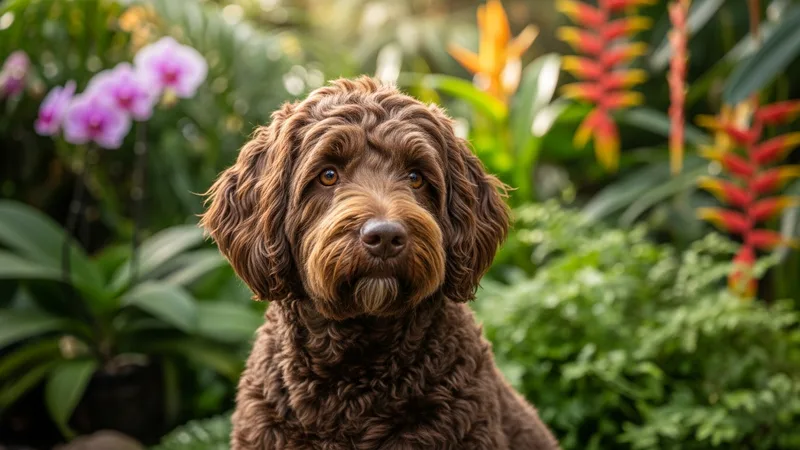
The Bernedoodle is the cross between a Bernese Mountain Dog and a Standard Poodle, developed to combine the Bernese's calm, loyal character with the Poodle's low-shedding coat. Its distinctive tricolour markings make it one of the most visually striking doodle crosses on Singapore dog runs.
Can a Bernedoodle live in an HDB flat?
NoNot on the HDB approved-breed list
Not on HDB's approved small-breed list, so it cannot be kept in a flat under the standard rules.
HDB sets and maintains the approved-breed list. Check the current rules at HDB.gov.sg →
Full list of HDB-approved breeds on this site →At a glance
- Size category
- Large
- Weight
- 30 to 45 kg
- Height
- 55 to 70 cm
- Lifespan
- 12 to 15 years
- Energy level
- ●●●○○ 3/5 (editorial, unvalidated)
- Shedding
- ●○○○○ 1/5 (editorial, unvalidated)
- Heat tolerance
- ●○○○○ 1/5 (editorial, unvalidated)
- Barking
- ●●○○○ 2/5 (editorial, unvalidated)
- Trainability
- ●●●●○ 4/5 (editorial, unvalidated)
- Grooming needs
- ●●●●● 5/5 (editorial, unvalidated)
- Origin
- Canada (developed by Sherry Rupke, 2003)
Editorial climate-care note
Heat tolerance rated 1 out of 5. The Bernese Mountain Dog is a cold-weather breed originally developed for alpine working conditions, and this heritage does not disappear in the Bernedoodle cross. Singapore's year-round 28 to 32 degree Celsius temperatures sit at the absolute upper limit of this dog's comfortable range. Rigorous exercise scheduling (early morning and post-sunset only), a very short professional clip year-round, air-conditioned rest, and permanent access to fresh water are all non-negotiable for Bernedoodle ownership in Singapore.
This score is not a safe temperature or exercise limit. Any dog can develop heatstroke.
Plan activity around your dog, not a timer
A breed score cannot tell you how many minutes are safe today. Avoid hot conditions, watch your dog's breathing, and agree an activity plan with your vet.
Read PDSA's heatstroke guidance →Common health issues in Singapore's climate
Build a care budget
- Year 1
- S$7,072 to S$9,568
- Over 10 years
- S$65,451 to S$88,551
Illustrative planning assumptions for food, grooming and routine vet care, with inflation and a year-one setup uplift. These are not verified provider quotes or a lifespan prediction. Adjust the calculator to current quotes; add insurance, boarding and emergencies separately.
Run the full lifetime cost calculator →The Bernedoodle is a cross between a Bernese Mountain Dog and a Poodle, first bred intentionally in Canada in 2003 by breeder Sherry Rupke, who wanted to pair the Bernese Mountain Dog's calm, family-centred temperament with the Poodle's lower-shedding coat. It is a cross, not a standardised breed. No national kennel club maintains a breed standard for the Bernedoodle, there is no single registry that judges dogs against one agreed set of traits, and outcomes vary between litters and between generations (an F1 is a straight Bernese x Poodle cross; an F1b is bred back to a Poodle, and so on). Everything below, including the numbers on this page, describes a typical range for a large, standard-cross Bernedoodle. Your dog may sit anywhere within that range, or occasionally outside it.
That variability is the honest starting point for anyone considering one. A Bernedoodle bred from a Standard Poodle, like the one this page describes, is a large dog. A Bernedoodle bred from a Miniature or Toy Poodle is a much smaller one, with a different exercise and space profile entirely. Ask any breeder which Poodle size sits behind a specific litter before you assume anything about the adult size, temperament or grooming load you're signing up for.
Personality and temperament
Most Bernedoodles sit at the calmer end of the doodle spectrum. The Bernese Mountain Dog is not a high-drive working breed, and that shows in the cross: owners commonly describe Bernedoodles as affectionate, patient with children, and more content to settle at your feet than to bounce off the walls. They tend to be sociable with other dogs and form strong attachments to their household, sometimes to the point of following you from room to room.
The less flattering parts are worth saying plainly. The Bernese side contributes a streak of stubbornness that Poodle intelligence doesn't automatically cancel out, and a fair number of Bernedoodles go through an awkward, wilful adolescent phase, roughly between six months and two years old, that catches first-time owners off guard. A dog that bonds this closely to its people can also struggle with being left alone, and some individuals are prone to velcro-dog behaviour or separation distress if alone time isn't built up gradually from puppyhood. The coat that doesn't shed onto your sofa still needs daily attention, which is a genuine time cost many buyers underestimate until they're living with it. And because this is a large, strong adult dog by twelve to eighteen months, an unruly one is a real handling problem, not a cute one. None of this makes the Bernedoodle a difficult dog in the wrong sense, but it is not a low-maintenance dog either, in temperament or in coat.
Exercise in Singapore's climate
Singapore's climate is the least forgiving part of Bernedoodle ownership. The Bernese Mountain Dog side was developed for alpine farm work in Switzerland, built for cold rather than heat, and that heritage carries into the cross even with a Poodle coat layered on top. Singapore's daily minimum temperature is usually 23 to 25 degrees Celsius overnight, climbing to a daily maximum of 31 to 33 degrees by afternoon, with May the warmest month at a 24-hour mean of 28.6C and December and January the coolest at 26.8C. Average relative humidity sits around 82% year-round, and climbs above 90% in the early morning, only dropping to around 60% on the driest afternoons (Meteorological Service Singapore). For a dog built for snow, that is a genuinely demanding baseline, every day of the year, not just on hot ones.
In practice, this means walking early in the morning or after sunset, when the temperature has come off its peak, rather than in the midday or early afternoon heat. Keep sessions shorter and slower than you would for a heat-tolerant breed, and watch for the early signs of overheating: heavy panting that doesn't settle, drooling, a wobbly or reluctant gait, or a dog that wants to lie down and stop. Any of those is a reason to get into shade and water immediately, not to push on. Between walks, a Bernedoodle in Singapore needs reliable access to a cool, air-conditioned or well-ventilated indoor space to recover in. A dog left in a hot, humid outdoor area for long stretches during the day is working against its own biology.
Coat and grooming in the humidity
The Poodle-cross coat is usually the biggest practical surprise for new Bernedoodle owners. "Low-shedding" does not mean low-maintenance. The wavy or curly coat that results from the Poodle side grows continuously rather than shedding out on a cycle, and loose hair that would fall out on a shedding breed instead tangles into the coat and mats, especially at friction points: behind the ears, in the armpits, around the tail, and in the groin. In Singapore's humidity, that process is faster and less forgiving than it would be in a drier climate, because a coat that stays damp near the skin for longer gives bacteria more time and a better environment to establish.
That matters for more than comfort. Cornell University's College of Veterinary Medicine notes that matted areas of coat hold moisture against the skin, which raises the risk of hot spots (pyotraumatic dermatitis), a fast-developing, painful skin infection, and lists thorough drying and regular grooming to remove mats among the key prevention steps. A Bernedoodle that goes weeks without brushing in Singapore's humidity is at real risk of exactly this. In practical terms that means daily brushing with a slicker brush and a comb that reaches down to the skin, not just over the top of the coat, and professional grooming on a schedule tight enough to stay ahead of matting rather than catch up with it. This page's annual grooming cost estimate reflects that frequency: this is one of the higher grooming bills among doodle crosses, and it is a recurring cost for the dog's whole life, not a one-off.
Check ears, paws and skin folds after every walk, particularly in wet weather. Ears that stay damp under floppy coat are a common source of infection in coated breeds generally, and a quick dry-off after rain or a bath is worth the two minutes it takes.
Diet and feeding
Heat and humidity change some practical details of feeding, even though they don't change what a healthy adult dog needs nutritionally. Dry kibble left out in a humid Singapore kitchen absorbs moisture and can spoil or attract pests faster than the same food would in a drier climate, so store it in a sealed, airtight container out of direct heat, and don't leave a bowl of dry food sitting out for extended periods. Fresh water needs to be available at all times, and in the heat that usually means checking and refilling bowls more often than the label on the food bag would suggest, since a dog exercising and panting in humidity loses more fluid than one in a temperate climate.
Because the Bernese side of this cross is a large, deep-chested dog, and deep chest conformation is a recognised risk factor for gastric dilatation-volvulus (bloat), a rapidly progressive, life-threatening emergency according to the American College of Veterinary Surgeons, it is worth feeding two or more smaller meals through the day rather than one large one, avoiding vigorous exercise for a period before and after eating, and not switching foods abruptly. These are general precautions for large, deep-chested dogs rather than Bernedoodle-specific rules, and they're worth raising with your vet directly rather than treating as a substitute for veterinary advice. Portion sizes should be set with your vet or a feeding guide matched to your individual dog's weight and activity, not a generic breed average, given how much adult size varies across this cross.
Training
The Poodle side of this cross is one of the more biddable, quick-learning breeds going, and that intelligence generally carries through: most Bernedoodles pick up commands fast and respond well to reward-based training. What makes training harder is not a lack of intelligence but the Bernese side's independent streak, which can show up as a dog that understands exactly what you're asking and decides, for a moment, that it would rather not. That combination, quick to learn and occasionally unwilling to comply, is different from a genuinely difficult-to-train dog, and it responds well to consistency: short, frequent sessions, clear boundaries from puppyhood, and patience through the adolescent phase rather than escalating pressure.
Early socialisation matters more than usual for a dog that will reach a large adult size and bond intensely with its household. Get a Bernedoodle puppy comfortable with being handled, with visitors, with other dogs, and with short periods alone, well before adolescence, and continue it through the awkward stubborn phase rather than assuming it will resolve on its own. A large, strong, occasionally wilful adult dog that was never taught to walk politely on a lead or settle when asked is a much harder problem to manage than the same dog would have been as a well-socialised puppy.
Health
Because the Bernedoodle is a cross, there is no body of health data measured on Bernedoodles themselves in the way there is for an established, standardised breed. What follows is what each parent breed is documented to carry a predisposition to, from recognised breed and veterinary authorities, not a diagnosis or a prevalence figure for the cross itself. A cross can inherit a condition from either parent breed, from both, or from neither, and it's worth being clear about one thing directly: hybrid vigour, the idea that crossing two breeds automatically produces a healthier dog, is not a guarantee. A 2024 Royal Veterinary College study comparing three popular Poodle-cross designer breeds (Cockapoo, Labradoodle and Cavapoo) against their purebred parent breeds, across 57 health conditions in over 9,000 dogs, found no consistent health advantage for the crossbreeds: the great majority of comparisons showed no meaningful difference between crossbreeds and purebreds, and crossbreeds showed higher odds of a condition about as often as they showed lower odds. Bernedoodles were not among the crosses in that study, but the finding is a reasonable caution against assuming a cross is automatically the "healthy" choice between two breeds.
On the Bernese Mountain Dog side, the Bernese Mountain Dog Club of America documents hip and elbow dysplasia, osteochondritis dissecans and other joint conditions as significant concerns in the breed, alongside eye conditions including progressive retinal atrophy, cataracts, entropion and ectropion, and heart conditions including subaortic stenosis. The same source reports that in its 2005 member health study, 67% of Bernese Mountain Dogs that had died had died of some form of cancer, with histiocytic sarcoma identified as the most prevalent type; it also lists hypothyroidism, inflammatory bowel disease, allergies, von Willebrand's disease (an inherited clotting disorder) and bloat among conditions seen in the breed. The UK Kennel Club recommends hip and elbow screening under the BVA/KC schemes before breeding Bernese Mountain Dogs, reflecting the same joint concerns.
On the Poodle side, the UK Kennel Club's health testing recommendations for the Standard Poodle include DNA testing for two forms of progressive retinal atrophy and for von Willebrand disease type 1, plus eye screening and hip testing, which points to overlapping eye and joint concerns with the Bernese side, and a separate, breed-specific clotting-disorder risk. Cornell University's College of Veterinary Medicine names Standard Poodles specifically among the large, deep-chested breeds at elevated risk of GDV (bloat), alongside breeds such as Great Danes and Weimaraners.
Matched against this page's own health-issue flags for this breed, that background lines up: joint and mobility problems and heart conditions are documented concerns on the Bernese side, eye conditions are documented concerns on both sides, and hot spots are a coat-and-humidity issue rather than an inherited one, covered in the grooming section above. None of this is a substitute for a vet's assessment of your individual dog, and if you're buying rather than adopting, ask to see the health testing results (hips, elbows, eyes, and relevant DNA panels) for both parents, not just one side of the pedigree.
Housing and space in Singapore
HDB sets and maintains the approved-breed list for flats, and this cross is not currently on it. Check the current rules directly at HDB before making any plans around a specific flat. In practice, that steers a large, standard-cross Bernedoodle towards condominium or landed housing, where you'll also want genuine indoor space and a shaded outdoor area, given how much time this dog needs to spend out of the heat.
Ownership limits sit separately from the approved-breed question and come from AVS rather than HDB. Under AVS's rules, an HDB flat may keep a maximum of one dog of an approved small breed plus up to two cats, and no dog on the Specified dogs list; private property may keep up to three cats or dogs in combination. Every dog in Singapore also needs to be licensed with AVS: at the time of writing, August 2026, a sterilised dog's licence costs from S$15 for one year up to S$35 for three years or a one-time licence, with a 10% rebate for GIRO, online or AXS payment (unsterilised dogs are charged more). AVS has stated that dog and cat licence fees will be brought under one harmonised structure from 1 September 2026, so check the current fee at the time you licence your dog.
Getting a Bernedoodle: buying and adoption
Because this is a cross rather than a standardised breed, there's no breed club or single registry to lean on for a guarantee of quality, which puts more weight on the individual breeder or source. Ask directly for documented health testing on both parents, not just the Bernese parent or just the Poodle parent: hip and elbow scores, eye screening results, and relevant DNA test results for conditions like von Willebrand disease. Ask which generation you're looking at (F1, F1b, or further), and which size of Poodle sits behind the litter, since that determines the adult size and coat type you'll actually end up living with. A responsible source will answer these questions specifically and show you paperwork, not just describe the parents in general terms. Be wary of anyone who can't or won't produce documentation, or who is vague about the Poodle parent's size.
Adoption is worth checking seriously before you commit to buying rather than treated as a fallback. Contact rescue and rehoming groups and check current listings rather than assuming a puppy from a breeder is the only route; availability of any specific cross through rescue changes over time and is worth checking directly rather than assuming either way. An adult rescue dog also comes with a known, visible size, coat and temperament already, rather than the uncertainty of a cross-breed puppy whose adult size and coat depend on genetics you can't see yet.
Life stages
As a puppy, a Bernedoodle needs the same early groundwork as any large-breed puppy: gentle, consistent socialisation, coat handling and brushing introduced early so grooming isn't a fight later, and exercise kept short and low-impact while growth plates are still closing, since too much high-impact activity too young is a risk factor for joint problems in a breed already carrying joint concerns from its Bernese side. Adolescence, roughly six months to two years, is typically where the stubborn streak and any separation sensitivity show up most, and where consistent training pays off most. As an adult, expect a settled, affectionate dog that still needs daily grooming, climate-appropriate exercise, and genuine indoor space to retreat to. In its senior years, watch for the slower, stiffer signs of joint wear that the Bernese side is prone to, and keep vet check-ups regular, since early management of joint and heart conditions generally gives a better outcome than catching them late. Bernedoodles typically live 12 to 15 years with good care.
Annual cost in Singapore
Editable planning estimates, not verified provider quotes or a prediction of your dog's bills. Boarding, one-off equipment and emergencies are additional.
- Food
- S$2,200
- Grooming
- S$2,200
- Routine vet
- S$2,000
- Sum of the three
- S$6,400/year
Run the lifetime cost calculator →
Get a current insurance quote for your dog's age and circumstances. Compare exclusions, waiting periods, excess and cover limits. Compare policy questions here →
Frequently asked questions
Is a Bernedoodle HDB-approved in Singapore?
No. The Bernedoodle is not on the HDB approved-breed list, so under current rules it cannot be kept in an HDB flat. It may still suit private housing. Always check the latest HDB and AVS guidance.
Do Bernedoodles bark a lot?
Our current barking assessment is: is fairly quiet (editorial estimate). It has not been independently validated. Ask about this dog's observed behaviour, triggers and time alone; the breed label cannot predict your neighbour's experience.
How much grooming does a Bernedoodle need?
Our current grooming assessment is: needs a lot of grooming, including regular professional trims (editorial estimate). Confirm the individual coat-care routine and any professional grooming with the rescue, groomer or vet. The score is not a measured frequency or price.
How does a Bernedoodle cope with Singapore's heat?
An editorial heat score cannot establish a safe temperature or walk duration for an individual dog. Activity, humidity, health, age and body shape matter. Avoid hot conditions, provide shade and water, and ask your vet about an appropriate activity plan.
Is a Bernedoodle a good breed for a first-time owner?
Our household-fit note is: Editorial: may need more support. This is not a validated prediction. Assess the individual dog, your daily capacity, training support and known care needs before deciding.
How much does a Bernedoodle cost to keep in Singapore?
The stored planning assumption is S$6,400 a year for food, grooming and routine veterinary care. It is not a verified typical cost for this breed. Replace it with current quotes and your own usage; add setup, licensing, insurance if chosen, boarding and emergency savings separately.
Other large breeds to consider

A Bernedoodle in Singapore, the short version
Bernedoodles have confirmed availability in Singapore through AVS-licensed importers including Dawgs and Co. and WhatUpDawg, with puppies arriving from Ireland, Australia, and North America. Prices typically run from SGD 7,000 to 15,000. The breed is restricted to condo or landed property, and HDB does not currently list it on the approved-breed list for flats. Heat tolerance rates just 1 out of 5, so plan early morning or post-sunset walks only, a short clip year-round, and permanent air-conditioned rest. Local vets commonly flag joint mobility, heart and eye conditions, and hot spots. Rescue placements are rare for this newer cross; most owners source through the licensed importers above.
Find Bernedoodle-friendly spots in Singapore
Good spots to visit with a Bernedoodle in Singapore.
 Breed fit quiz Does a Bernedoodle actually suit your life? Answer a few questions about your lifestyle and see how well this breed matches your real setup. Find out →