
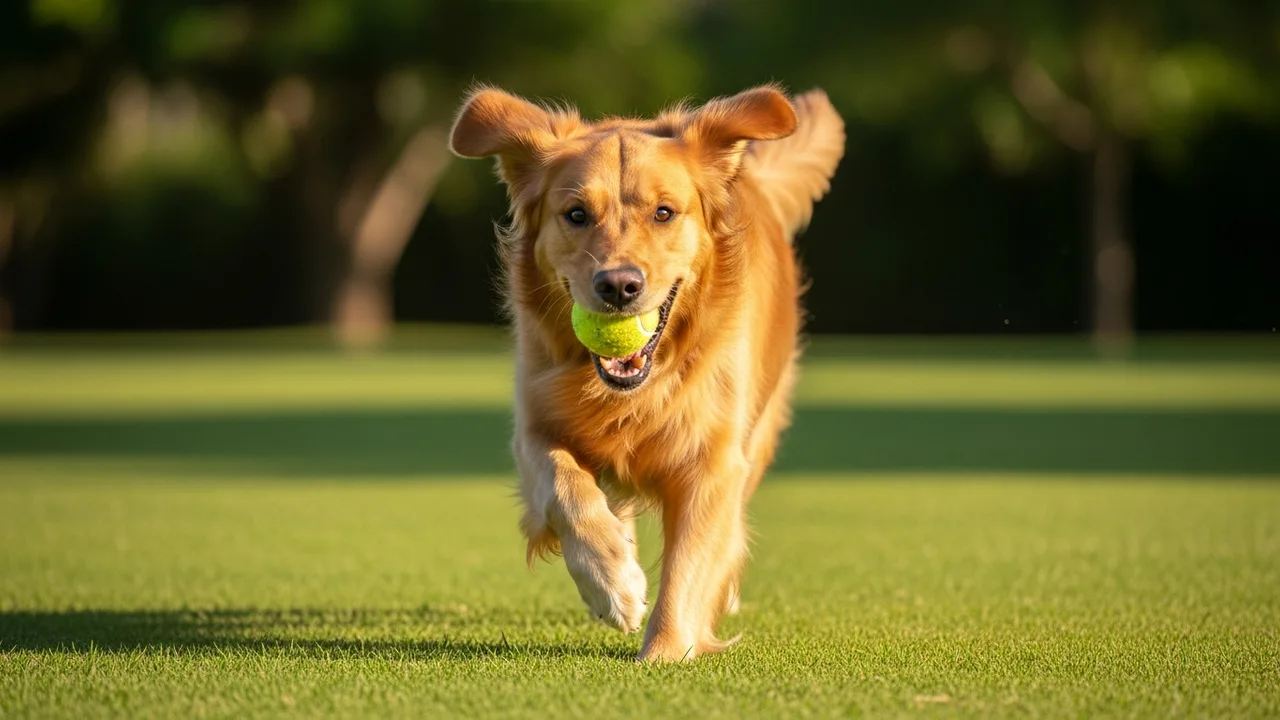

Flyball is one of the most exciting dog sports to watch: a relay of dogs tearing down a lane over hurdles, triggering a box that fires out a ball, catching it and racing back so the next dog can go. It is fast, loud and full of team energy. Singapore has a small local scene through one training school, which can still be a brilliant outlet for the right ball-mad dog.
What flyball is
Flyball is a team relay race, and it is as chaotic and joyful as that sounds. A team fields four dogs that run one at a time down a lane of four low hurdles to a spring-loaded box at the far end. The dog hits a pad on the box, which fires a tennis ball into the air, catches it, and races back over the hurdles carrying the ball, at which point the next dog launches. The first team to get all four dogs through a clean relay wins the heat. It is timed, it is head to head against a second lane, and it is loud, because a team of waiting dogs watching their teammates run is an excited team.
The appeal for the dog is obvious: it combines the two things a ball-driven dog loves most, running flat out and chasing a ball, and wraps them in the social energy of a team. The appeal for the handler is the teamwork, both with the dog and with the other people on the team, since a clean relay depends on tight timing between dogs. Because it is so high-arousal, flyball also demands real training discipline to keep it controlled and safe, which is part of what makes it satisfying to build.
The Singapore scene
Internationally, flyball has leagues, sanctioned tournaments and hundreds of clubs. Singapore's scene is smaller: at the time of writing, one team runs through one training school rather than a league of clubs racing regularly. Think of it as recreational team training, a chance to learn the sport and share the fun, rather than a local competition ladder.
If your dog is fast, ball-mad and happy working around other excited dogs, that single route in may be all you need. You can learn together, meet people who enjoy the same lively dogs and give all that drive somewhere positive to go. Owners looking for regular competitive racing will find it abroad, but the joy of the run and the handover is already here.
Whether your dog would suit it
Flyball is a specialist’s sport in terms of temperament, and not every dog is a fit. The ideal flyball dog is fast, intensely motivated by a ball, and reliable at retrieving it, because the whole run hinges on the dog grabbing the ball and bringing it straight back. It also needs to cope with a high-arousal, noisy environment full of other excited dogs without losing its head or getting into conflict, so a degree of social steadiness is essential. Interestingly, small dogs are often prized, because the height of the hurdles is set to the smallest dog on the team, so a quick little dog can be an asset rather than a limitation.
The dogs that do not suit it are worth naming too. A dog that is anxious or reactive around other dogs will find the team environment stressful rather than fun. A dog with hip, elbow or other joint problems should avoid the repeated jumping, and puppies whose growth plates have not closed should wait. Flat-faced breeds that struggle to cool themselves are poorly matched to any all-out sprinting sport in this climate. If your dog is sound, sociable and lives for a ball, it is a candidate; if not, one of the other activities in this cluster will serve it better.
How to try it, and what to build first
If flyball appeals and your dog fits the profile, the route in is the single training school that runs it: PUPS runs a flyball class built around its CrazyK9 team, listed alongside its other dog-sports training. The first step is simply to make contact, ask about their intake and whether you can watch a session, and confirm the current schedule and cost directly. Because the scene is small, availability can be limited, so patience helps. Approach it as trying a sport for enjoyment rather than joining an established competitive pathway, and you will get the most out of it.
Whatever you do, the preparation is the same as for any dog sport, and it pays off. Build a rock-solid recall and a genuine, enthusiastic retrieve, and work on your dog’s ability to be excited and then settle again on cue, because flyball lives at the high end of arousal. Our dog training in Singapore guide covers those foundations. And because flyball is an explosive sprinting sport, read our heatstroke first aid guide and take the heat seriously, training indoors or in the cool hours with rest and water between runs. If flyball turns out not to be accessible, the closely related thrills of agility and canicross are both more established here.