Growling over a food bowl looks like a behaviour problem, but it is really a communication signal, and how you respond to it in the first few weeks decides whether it fades or escalates. Here is what resource guarding actually is, and the training approach that has the evidence behind it.
6 min read · Updated 11 September 2026
Growling over a food bowl is not a dominance problem, it is a dog telling you it is worried something valuable is about to be taken away. How you respond in the first few weeks largely decides whether that worry fades or escalates into something more serious.
What resource guarding actually looks like
Resource guarding covers a spectrum of behaviour, and the growl or snap that finally gets an owner's attention is usually the last sign in a sequence, not the first. According to Preventive Vet, earlier and subtler warning signs include freezing over the item, eating faster when approached, a braced or stiff posture, body-blocking, a hard sideways stare, or pinned-back ears. These signs are easy to miss or dismiss as normal eating behaviour, which is often why owners are caught off guard when a growl or snap eventually shows up.
A peer-reviewed study of shelter dogs, published on PMC, found that 14.4% of dogs assessed during behavioural evaluation were classified as resource guarders. The reassuring detail in that same study is that 83% of those dogs showed only mild to moderate guarding, and even among the smaller group flagged as severe, 96% were still successfully placed in a home and never returned. Resource guarding is common, and in most cases, manageable.
Why dogs guard, and what makes it worse
Guarding behaviour is rooted in a dog's underlying anxiety about losing access to something it values, whether that is food, a toy, a resting spot, or even a person. It becomes more likely, not less, when a dog has previously had an item taken away without warning, which teaches the dog that a human approaching means something is about to be lost. This is why the single most damaging response to a growl is punishment.
The American Veterinary Society of Animal Behavior has taken a clear public position against punishment-based correction for this kind of behaviour, warning that it can increase fear, anxiety, and aggression while damaging the relationship between dog and owner. Punishing a growl does not remove the underlying anxiety, it just teaches the dog to skip the warning and go straight to a snap next time, which is a considerably more dangerous outcome for everyone in the household.
The trade-up method: what actually works
The training approach with the strongest evidence behind it combines desensitisation and counterconditioning, often called the "trade-up" method. The principle is straightforward: rather than taking an item away, you teach the dog that a person approaching means something even better is about to arrive. In practice this means approaching from a distance the dog is still comfortable at, tossing a higher-value treat near the guarded item without reaching for it, and gradually closing that distance over repeated short sessions as the dog's body language stays relaxed.
Alongside this, the ASPCA recommends immediate management steps while training is underway: feed the dog somewhere quiet where it will not be approached mid-meal, avoid reaching into the bowl or "testing" the dog by taking food away as a form of training, and if there are multiple dogs in the household, feed them separately rather than side by side. Teaching a reliable "drop it" and "leave it" cue, taught with positive reinforcement well before it is ever needed in a real guarding situation, also gives you a workable alternative to physically taking something from the dog's mouth.
When to bring in a professional
Mild guarding, a stiffened posture or a low growl that stops as soon as you back off, is often manageable with the management and trade-up steps above. Guarding that involves lunging, snapping, biting, or guarding that is spreading to more items or more people, needs a certified professional before you attempt any hands-on training. A veterinary behaviourist can also rule out pain or a medical cause, since a dog in discomfort will sometimes guard resting spots or resist being approached in ways that look behavioural but are actually medical.
In Singapore, this usually means asking your regular vet for a referral to a veterinary behaviourist or a certified force-free trainer with specific experience in aggression and guarding cases, rather than a general obedience class. Ask directly about their approach before booking: a trainer who talks about "trade-up," desensitisation, and counterconditioning is working from the same evidence base as the vets cited above, while anyone who suggests physically correcting or dominating a guarding dog is recommending exactly the approach AVSAB warns against. If a household has young children, treat professional guidance as the starting point rather than a last resort, since the margin for error is smaller and management alone is rarely enough to make a home fully safe.
Frequently asked questions
Is resource guarding the same as aggression?
Not in the way most owners mean it. Resource guarding is a specific, context-dependent behaviour driven by anxiety about losing an item, not a general temperament trait. A dog that guards its food bowl can otherwise be entirely friendly and non-reactive in every other context.
Should I stop my dog from ever having toys or bones if it guards them?
Removing every trigger permanently is management, not training, and it does not address the underlying anxiety. It can be a sensible short-term step while you start a proper desensitisation programme, particularly in a household with children, but the goal of training is to change how the dog feels about being approached, not to remove every valuable item from its life indefinitely.
My puppy is already showing guarding behaviour. Is this a bad sign?
Mild guarding in puppies, such as eating faster when approached, is common and often responds very well to early trade-up training precisely because the anxiety has not had time to become entrenched. It is worth addressing early rather than assuming it is normal and will resolve on its own.
Can resource guarding be fully cured, or just managed?
Many dogs improve enough that guarding stops being a practical problem in daily life, especially when training starts early and consistently. Dogs with a more severe or longer-established pattern may always need some ongoing management alongside training, which is a normal and reasonable outcome rather than a training failure.
More dog-friendly guides
-
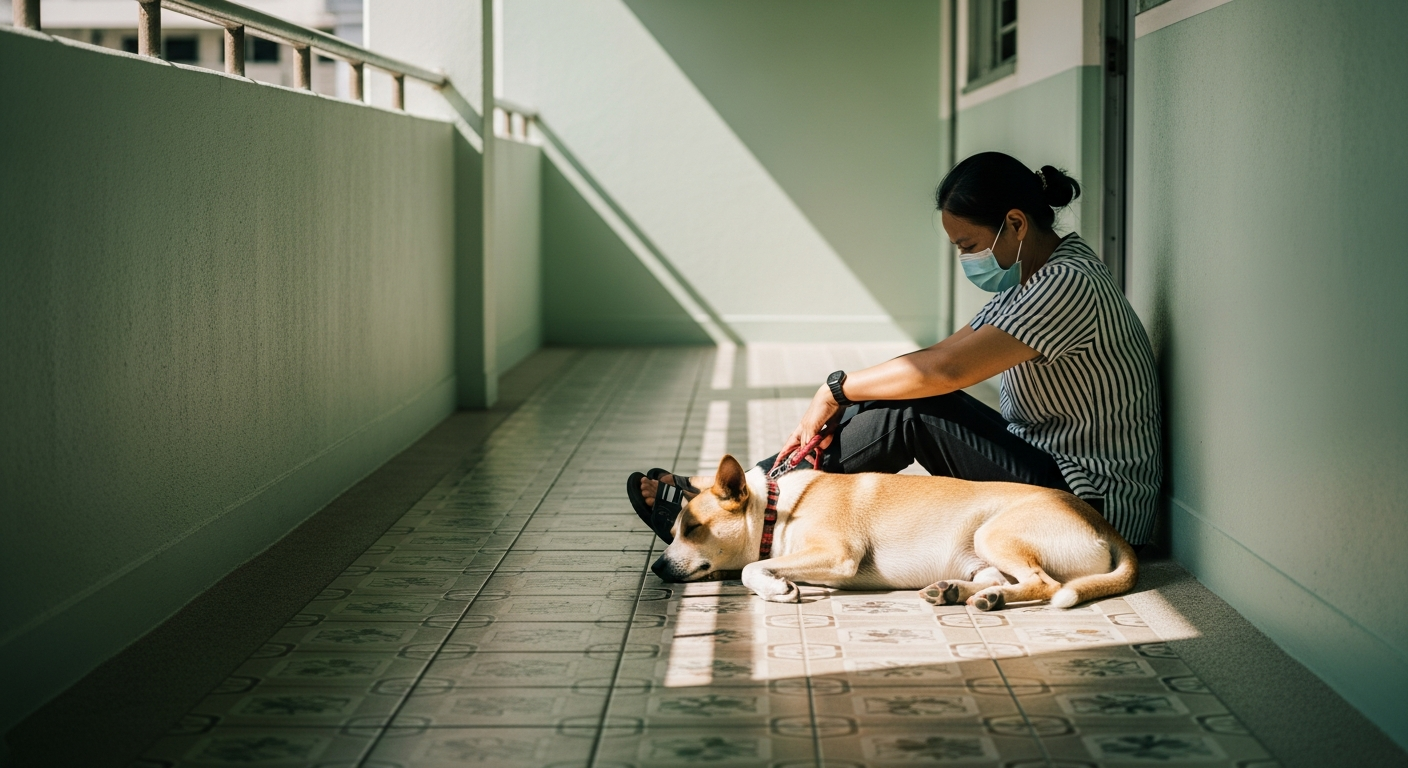 HDB barking complaints: how to manage your neighbour situation A neighbour complaint about your dog's barking is serious in an HDB context, but it is a problem with a clear pathway through it. This guide covers how to identify the cause, reduce the noise now, manage a formal complaint if one has been filed, and when to bring in professional help.
-
 Vet bills in Singapore: what to expect and how to plan Plan veterinary spending around your dog: ask for written estimates, compare the scope of care, understand insurance terms and prepare for unexpected bills.
-
 Singapore dog vaccination schedule, explained Core vaccines, puppy timing, leptospirosis, kennel cough, titre testing, and how your AVS licence connects to it all. Here is what Singapore dog owners actually need to know about keeping jabs current and records straight.
-
 Your rescue dog's first 30 days in Singapore Bringing a rescue dog home is a different experience from raising a puppy, and the first 30 days require patience more than training. This guide covers what to expect during the decompression period, from the first quiet hours in a HDB flat to the point where your dog genuinely starts to feel at home.